Injury-Proofing · guide
Front-of-Knee Pain After Running: What to Change
Pain around the kneecap on stairs may fit patellofemoral pain. Learn how to adjust running, build strength, and recognize signs that need care.
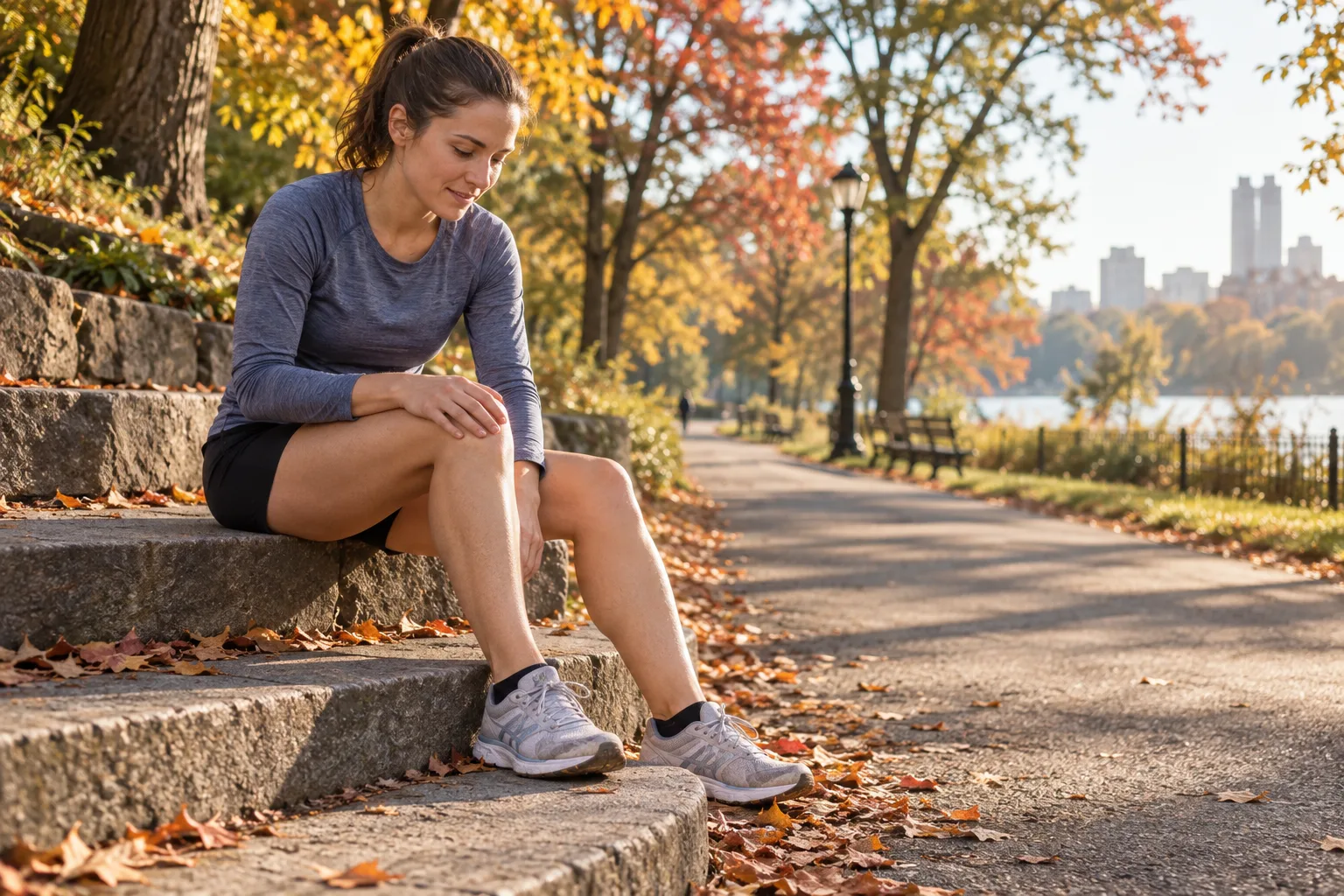
The run itself felt manageable. Then the stairs home made the front of your knee ache. Pain around or behind the kneecap during stairs, squats, or running can fit patellofemoral pain, often called runner’s knee. The pattern is a clue, not a diagnosis: other knee problems can feel similar.
Medical disclaimer: This article is general information, not a diagnosis or personal treatment plan. A sports medicine clinician or physical therapist can examine your knee and tailor a plan, especially if symptoms persist or interfere with walking.
Start with the pattern, not a tracking story
The American Academy of Orthopaedic Surgeons describes patellofemoral pain as a dull ache at the front of the knee that can worsen with running, stairs, squatting, or prolonged sitting with a bent knee. Those activities load the kneecap joint. They do not prove that the kneecap is grinding off its track, that one particular thigh muscle is weak, or that a brace will correct the cause.
Location matters. Pain on the outside of the knee has a different set of possibilities, discussed in our outer-knee pain guide. Pain with marked swelling, locking, or a recent twist needs an individual assessment rather than an internet label.
Change the load that provokes it
If a familiar easy run now brings on knee pain, skip the next speed session or hilly route and reduce the activity that clearly aggravates it. This is an editorial way to apply activity modification, not a tested mileage formula. Record when pain starts, whether your stride changes, and how stairs and walking feel later and the next morning. A shorter, flatter outing may be easier to judge than a long downhill run.
Stop running if pain becomes sharp, increases as you continue, or changes your gait. Do not use pain relief after warming up as permission to finish a workout. If even ordinary walking or stairs are painful, pause running and arrange a clinical assessment. The aim is to keep moving within tolerable limits while finding the right load, not to force a preset number of miles.
A randomized trial in runners with patellofemoral pain found that education about symptoms and training load belongs in treatment. It does not establish one safe pain score or a universal return-to-running schedule. Our guide to rebuilding after a missed week can help you plan a gradual return once walking and an easy run are comfortable, but persistent knee pain still deserves personalized care.
Build capacity at the hip and knee
The 2019 physical therapy clinical practice guideline recommends combined hip- and knee-targeted exercise for patellofemoral pain. A 2024 best-practice guide likewise places knee-targeted exercise and education at the center, with hip work and other interventions chosen for the person. This is stronger support than a claim that a ball squeezed between the knees can selectively “pull” the kneecap into place.
A physical therapist may choose a squat or sit-to-stand variation for the knee, plus a step-up, bridge, or side-lying hip exercise. The starting range, resistance, and progression depend on what you can do without a worsening response. These are examples of exercise categories, not a prescription. If an exercise repeatedly increases symptoms, scale it back and ask a clinician to adjust it. Our general strength guide covers performance-oriented lifting; rehabilitation may need a different starting point.
Treat cadence as an option, not a cure
For some runners, gait retraining can be an add-on. The clinical guideline says clinicians may use repeated cues to increase cadence or change other running mechanics. In a 2024 randomized trial, cadence and impact-focused retraining groups reported less running pain than a control group at follow-up. That does not mean every runner should raise cadence by 5% or 10%, or that changing foot strike is harmless for every leg.
If a clinician suggests a cadence experiment, try it briefly at an easy effort and watch the knee and any new calf or ankle discomfort. Do not use a watch number to override symptoms. Exercises and load decisions remain the core of the plan.
Red flags: know when to get help
Seek urgent medical care if you cannot bear weight, the knee is badly swollen or deformed, or it is hot and red with fever or feeling unwell. NHS knee-pain guidance lists these as reasons for prompt help. A knee that truly locks, gives way repeatedly, or became painful after a fall or twist also warrants a timely examination. If symptoms keep returning or are not improving with sensible load changes, book a sports medicine or physical therapy evaluation rather than cycling through braces and rest.
Pain on stairs is useful information about what your knee currently tolerates. Use it to adjust the next run and guide a proper assessment, not to diagnose a damaged kneecap from a single symptom.
Sources
- AAOS: Patellofemoral Pain Syndrome. Symptom pattern and conservative treatment overview.
- Patellofemoral Pain clinical practice guideline, Journal of Orthopaedic & Sports Physical Therapy, 2019. Hip and knee exercise and optional gait retraining.
- Best practice guide for patellofemoral pain, British Journal of Sports Medicine, 2024. Evidence synthesis and expert guidance on education, exercise, and tailored add-ons.
- Education, gait retraining, and exercise in runners with patellofemoral pain, randomized clinical trial. Training-load education and treatment comparison.
- Effects of two gait retraining programs, randomized controlled trial, 2024. Cadence and impact retraining outcomes.
- NHS: Knee pain. Urgent warning signs and care guidance.