Injury-Proofing · guide
Running Blisters: Prevention and When to Stop
Build a race-ready foot-care routine, understand the limits of blister tape research, and learn when a hot spot or painful blister means it is time to stop.
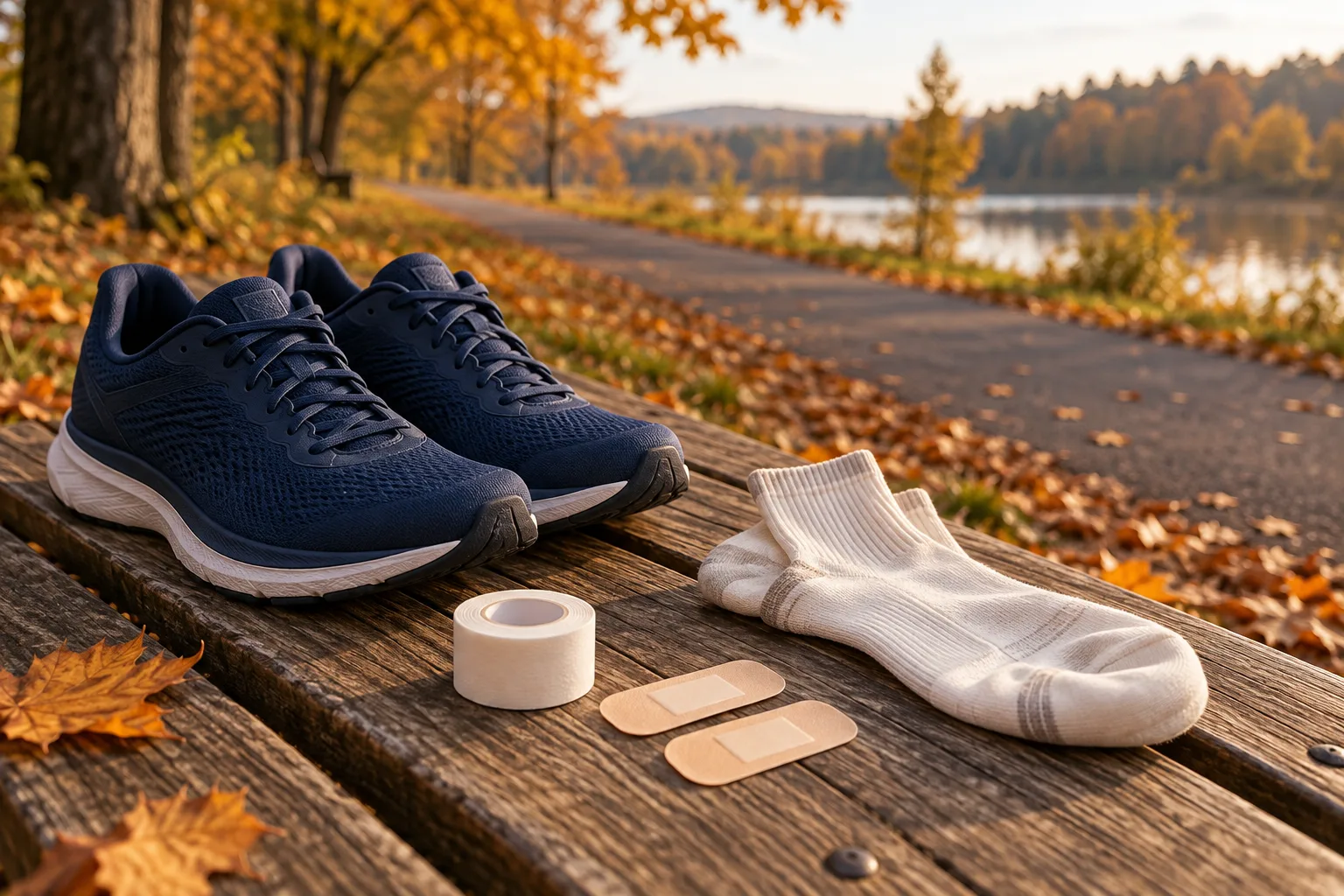
Your breathing feels controlled, your legs feel ready, and one spot under your foot starts to burn. That is a reason to stop and check, even if you are only a few miles into the run. Waiting for a visible blister is a poor race-day plan.
Foot care belongs in your race rehearsal alongside pacing and fueling practice. The useful question is what you can test beforehand—and what should end the run if that preparation fails.
Medical disclaimer: This guide provides general education, not a diagnosis or individualized wound treatment. Read our medical disclaimer. A painful or unexplained skin change needs assessment rather than an assumption that your shoe caused it.
Start with fit and socks
The American Academy of Dermatology recommends moisture-wicking or nylon socks and shoes that neither squeeze nor slide. Soft protective bandages may help areas that repeatedly rub. These are clinical recommendations, not a guarantee against blisters.
Our editorial approach is to treat the whole setup as one experiment: shoes, socks, lacing, and any protection. Test it on an ordinary training run before making it your race setup. A thicker sock changes how a shoe fits; adding protection is another reason to check comfort rather than assuming more layers are better.
If the pressure is at a toenail rather than the skin, see our separate black-toenail and shoe-fit guide. Replacing a shoe solely because a blister appeared can miss the actual fit problem; shoe mileage and wear answer a different question.
Does paper tape prevent blisters?
There is supporting research, with limits. In the 2016 Pre-TAPED II randomized trial, 128 runners entered six-stage, 155-mile ultramarathons. Researchers applied paper tape to selected areas of one foot and used untaped areas of that foot as the comparison. The study found a protective effect.
That does not establish a universal benefit for every sock, tape, or marathon runner. An earlier randomized trial published in 2014 did not find a statistically significant protective effect. The studies used different applications and comparisons; neither tested your personal race setup.
Our editorial takeaway: tape is an option to rehearse on intact skin, not a last-minute insurance policy. If you already know an adhesive irritates your skin, do not experiment with it on race morning. Ask a pharmacist or healthcare professional about suitable protection rather than copying a complex taping pattern from a race photo.
A hot spot is your cue to stop
The AAD advises stopping activity when skin becomes painful, uncomfortable, or red. For a runner, that means stop running and inspect the area rather than waiting for the next planned mile marker.
Our practical application is simple: move somewhere safe, remove the shoe, and check for a folded sock, debris, or an obvious rubbing point. Correcting the setup is an inspection step, not permission to resume through pain. If discomfort continues, end the run. During a race, use the medical station instead of trying to protect a time goal by limping onward.
If a blister has already formed
The NHS advises gently cleaning and drying it, then protecting it with a soft padded dressing. Do not deliberately burst it or peel away the skin if it opens. A pharmacist can help select a dressing; a large or very painful blister may need professional treatment.
Avoid the footwear responsible until the skin heals. The AAD also advises waiting for healing before returning to the activity that caused the blister. A bandage does not establish that the foot is ready for another long run.
For planning, replace the missed session rather than moving all of its miles into tomorrow. Your return-to-running plan can accommodate an interruption without turning it into catch-up training.
Red flags and when to seek care
Seek medical care promptly for warmth, pus, increasing pain or swelling, or redness around the blister. Redness may be less visible on darker skin. Very painful or recurring blisters, or several appearing without an obvious reason, also need assessment; do not assume every blister is friction-related.
If you have diabetes, use a lower threshold: the CDC advises seeing your doctor or foot doctor right away for a foot blister. Nerve damage can reduce pain sensation, so a foot that does not hurt is not necessarily uninjured.
Sources
- American Academy of Dermatology. How to prevent and treat blisters. Clinical skin-care guidance.
- Lipman GS, et al. Pre-TAPED II. Clinical Journal of Sport Medicine, 2016. DOI: 10.1097/JSM.0000000000000319. Primary randomized trial.
- Lipman GS, et al. Pre-TAPED. Wilderness & Environmental Medicine, 2014. DOI: 10.1016/j.wem.2014.06.013. Earlier primary randomized trial.
- NHS. Blisters. Wound care and reasons to seek assessment.
- CDC. Your Feet and Diabetes. Foot checks and prompt care for diabetes-related foot problems.
Sources checked October 21, 2026. Training-rehearsal and scheduling suggestions are editorial applications, not tested blister-prevention protocols.