Training · guide
Hip Extension for Runners: Control Before Load
A simple way to choose between glute bridges, hip hinges, and Romanian deadlifts without treating any one exercise as a running cure.
If you have 15 minutes for strength work, the list of glute bridges, single-leg bridges, hip thrusts, and deadlifts can feel longer than the workout. Pick the version you can control now. Add difficulty when the movement stays steady and the extra work fits around your running.
Hip extension means straightening a bent hip. A bridge lifts the pelvis from the floor; a hinge brings the torso back upright from a hips-back position. Both train the movement, but they put different demands on balance and loading. This is an exercise-selection guide for runners without current pain, not a way to diagnose a weak muscle or treat an injury.
Start on the floor if the movement is new
For a two-leg glute bridge, lie on your back with knees bent and feet flat about hip-width apart. Gently brace your abdomen, exhale, and lift your hips. Lower slowly. The American Council on Exercise (ACE) demonstration cautions against driving the hips so high that the lower back arches excessively.
Try a small set that you can finish with the same control you had on the first repetition. That is editorial coaching advice, not a tested prescription for faster running. A strong burning sensation in the glutes is not a required sign of a good exercise. If the lift causes joint or back pain, stop and reassess rather than pushing through more repetitions.
The single-leg bridge is an optional progression once the two-leg version is stable. If your pelvis twists or you need to thrust through your back, return to the simpler version. There is no evidence that every runner must master the single-leg bridge before doing useful strength work.
Learn the standing hinge before loading it
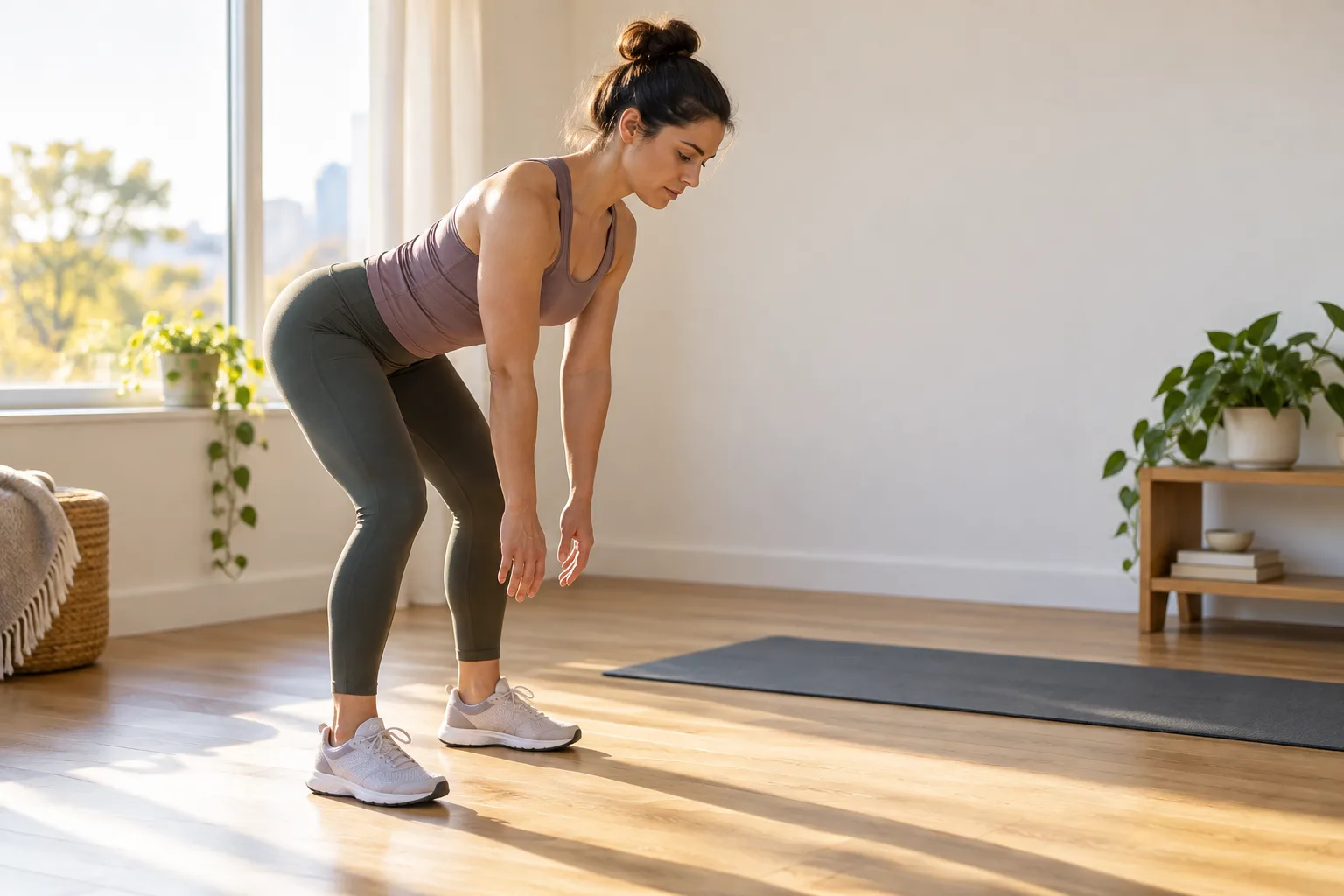
Stand with knees slightly bent. Move your hips back as your torso tips forward, then bring your hips forward to stand tall. Keep the motion centered at the hips and use a range you can control. This unweighted hinge lets you practice the pattern before a dumbbell or barbell changes the challenge.
ACE describes the Romanian deadlift as a loaded hinge. Its teaching guide recommends keeping the load close, the knees slightly bent, and the spine controlled. Lower only as far as you can maintain that position and feel tension in the back of the thighs; touching the floor is not the goal. Start with a light load if you are new to it, and seek in-person coaching if you cannot tell whether you are moving at the hips or repeatedly rounding your back.
An editorial progression:
- If a bridge is unfamiliar, practice the two-leg version first.
- If a standing hinge is hard to control, keep it unloaded.
- If adding weight changes your movement, reduce the load or range.
- If the last repetitions stay controlled and your next run feels normal, increase just one variable at a time.
This is a practical decision path, not a universal test with a fixed number of weeks or pounds. You can keep a bridge in your routine while learning the hinge; one does not have to replace the other.
Give it a place in your week
The 2026 ACSM resistance-training update recommends working the major muscle groups at least twice weekly for general health. It says bodyweight, bands, and home training can be effective, and training every set to failure is generally unnecessary. A bridge or hinge is one part of that whole-body work, alongside exercises for the knees, calves, upper body, and trunk. Our two-session strength framework shows one way to organize the rest.
Add a new movement on a day when you can observe its effect before your next important run. Avoid introducing an unfamiliar heavy hinge immediately before intervals or a long run. That scheduling advice is editorial; individual soreness and recovery vary. Record the exercise, load, movement quality, and how your next easy run felt. Progress only when the new work is repeatable and recoverable.
A review of resistance-training studies in runners found that heavy resistance work may improve running economy when added to running training. The studies did not show that a few beginner bridges improve race times, or that hip-extension exercises prevent knee, hip, or back injury. Treat this sequence as a way to build a sustainable strength habit, not a performance guarantee.
If pain is persistent, worsening, accompanied by swelling or marked weakness, or changes how you walk or run, stop adding load and seek a qualified clinician’s assessment. AAOS advises that exercise should not cause pain and recommends speaking with a doctor or physical therapist when it does. See our medical disclaimer for the limits of general training advice.
Sources
- ACE, Glute Bridge Exercise, exercise instructions.
- ACE, The Romanian Deadlift, coaching instructions, 2025.
- ACSM, Updated Resistance Training Guidelines, official summary, 2026.
- Heavy Resistance Training Versus Plyometric Training for Improving Running Economy and Running Time Trial Performance, systematic review and meta-analysis, 2022.
- AAOS, Hip Conditioning Program, exercise pain guidance.