Training · analysis
There Is No Standard Running Form
Reviews find many biomechanical patterns produce similar economy. What matters is managing knee load, respecting fatigue, and reading your own data.
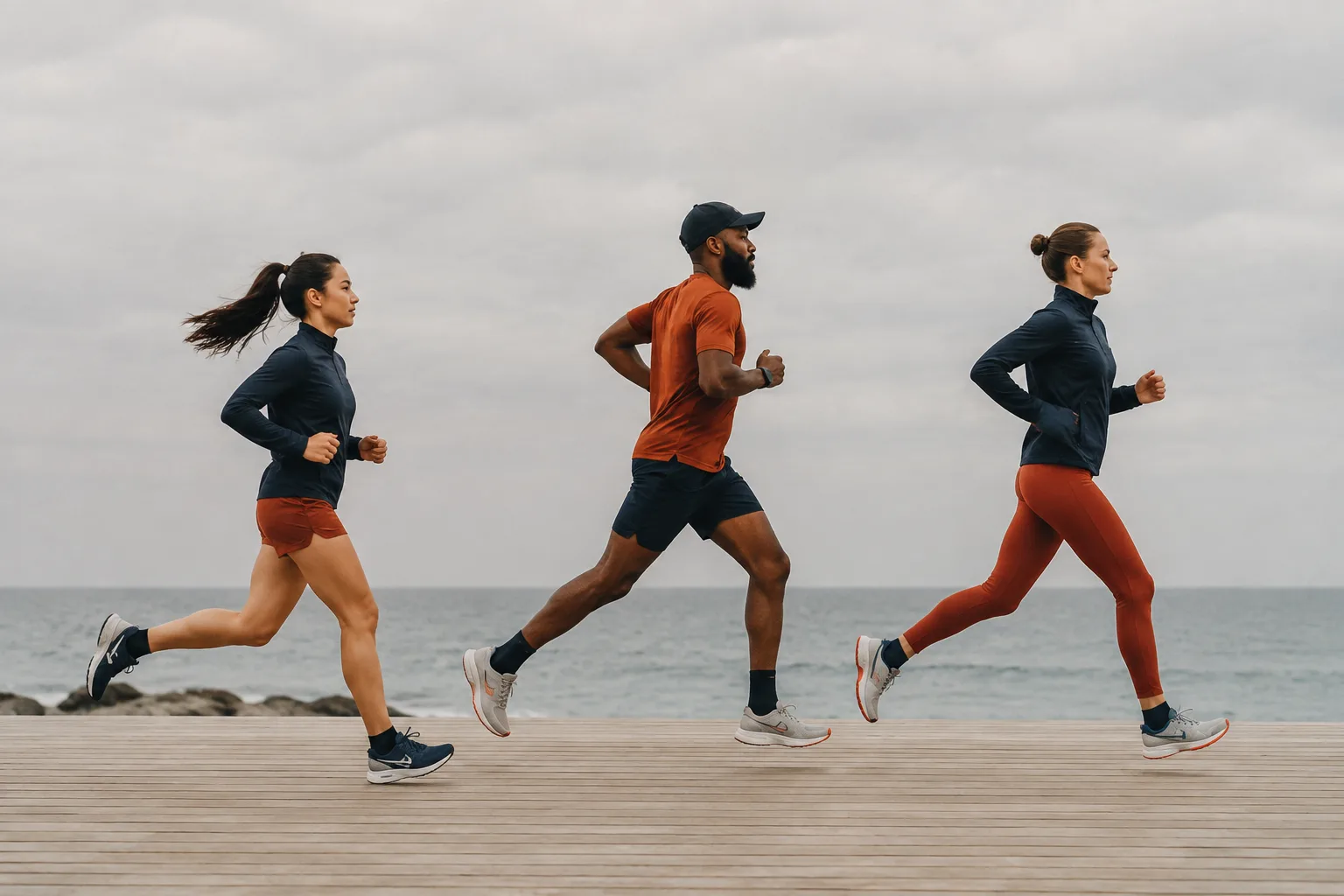
If you have spent time in running forums, you know the script. Someone posts a race photo and the diagnoses roll in: “Your knee dives inward.” “Your cadence is too low—at least 180.” “You’re overstriding, fix it before you get hurt.”
The diagnoses sound authoritative. The premise underneath them—that a correct running form exists, and deviations from it are defects—does not survive contact with the evidence.
Different shapes, similar economy
When researchers systematically reviewed observational studies linking biomechanics to running economy, the associations came back inconsistent: no single kinematic fingerprint reliably predicts who runs cheaply. Reviews comparing novice and experienced runners reach a similar conclusion from the other direction—experienced runners differ from beginners in many ways, but they do not converge on one template.
The practical implication is uncomfortable for forum experts: two runners can be equally fast and equally efficient with visibly different strides. Your friend’s “correct” mechanics may be wrong for your structure, your history, and your habits.
Where form actually matters: knee load
None of this means technique is irrelevant. It means the useful question changes from “Is my form correct?” to “Does this adjustment reduce the load on the tissue that is complaining?”
For the knee—home of the most common running injury—the dials are well mapped:
- Cadence. A systematic review and meta-analysis found that increasing step rate produces strong evidence of reduced peak knee flexion and moderate evidence of reduced patellofemoral joint stress.
- Step length. In controlled comparisons, shortening step length cut patellofemoral kinetics per step by roughly 15 to 20 percent, while lengthening it increased stress sharply.
- Landing pattern and posture. The same work found forefoot-strike conditions reduced knee joint loading per step by about 10 to 13 percent; a slight forward lean from the ankles works in a similar direction.
Notice what these are: adjustable variables, not commandments. The famous “180 steps per minute” number began as an observation of elite racers, most of them running much faster than a training party. If you are pain-free at 164, you do not have a defect. If you have recurring anterior knee pain, nudging cadence up 5 to 8 percent is one of the best-evidenced experiments you can run.
Fatigue rewrites your form anyway
Here is the part most form advice ignores: your mechanics are not constant. A 2026 systematic review of exercise-induced fatigue in running found a consistent cascade—ground contact time lengthens, ankle power and functional stiffness drop, and mechanical load shifts from the ankle toward the knee and hip. Impact-related measures like tibial acceleration and vertical loading rate tend to rise, and stride-to-stride variability balloons.
Translation: in the last miles of a hard or long run, your ankle stops paying full freight and your knee starts covering the bill. That vague knee ache that appears only late in long runs is often not a knee problem. It is an ankle-and-calf fatigue problem with a downstream address.
This is also why “the last few miles are where the real training happens” deserves suspicion. Work done with good form and a stable stride is training. Work done after your mechanics have visibly deteriorated is a bet that your tissues can absorb load your coordination is no longer distributing. The evidence-based move is unglamorous: when form comes apart, slow down. If slowing down does not restore it, end the run. A shortened session costs days; a stress reaction costs months.
Your watch is closer to a lab than ever
Gait analysis used to require a motion-capture lab, force plates, and reflective markers. Recent reviews of wearable sensors describe how far the gap has closed: inertial measurement units now capture spatiotemporal metrics like cadence and contact time within a few percent, estimate sagittal-plane joint angles within a handful of degrees, and—paired with machine learning—predict ground reaction forces with errors around 10 percent in validation settings. Estimates remain weaker for side-to-side and rotational motion, so treat those numbers skeptically.
You do not need to wait for the perfect version. Most modern watches already report ground contact time, left-right balance, and vertical oscillation. The mistake is reacting to a single workout. The value is in the trend line: if your ground contact time suddenly lengthens across a week, or left-right balance drifts consistently, that is a signal to check fatigue, foot or shin symptoms, or the new shoes before they force the question.
What to actually do
- If you are pain-free and progressing, leave your form alone. Chasing cosmetic changes adds load in new places and rarely makes anyone faster.
- If a specific pain keeps returning, change load, not identity. Try a modest cadence increase, a slightly shorter stride, and a quieter landing. Treat each as a short experiment with a defined symptom check—not a personality change.
- Respect the fatigue cascade. Harden the rule that deteriorating mechanics means slower pace or a shorter run.
- Read sensor trends, not snapshots. One strange run is noise; a week of drift is data.
The science of running form is shifting from “here is the template” to “here is how load distributes through your particular body, and here is how to notice when it stops going well.” That is better news for runners than any perfect stride ever was.
Sources
- The relationship between running biomechanics and running economy: a systematic review and meta-analysis of observational studies, Sports Medicine, 2024.
- What is the effect of changing running step rate on injury, performance and biomechanics? A systematic review and meta-analysis, Sports Medicine - Open, 2022.
- Influence of step length and landing pattern on patellofemoral joint kinetics during running, Scandinavian Journal of Medicine & Science in Sports, 2015.
- Lower-limb biomechanical adaptations to exercise-induced fatigue during running: a systematic review of injury-relevant mechanical changes, Life, 2026.
- Inertial measurement units (IMUs) for biomechanical analysis in sport, Sensor Review, 2026.
- The use of machine learning to estimate ground reaction forces during running: a scoping review, Sensors, 2026.