Gear · analysis
COROS PACE 4 Pro: Big Screen, Bigger Leap in Price
COROS adds a 1.47-inch sapphire AMOLED, titanium, 60-hour GPS and fast offline maps. Here is how the $449 PACE 4 Pro stacks up.
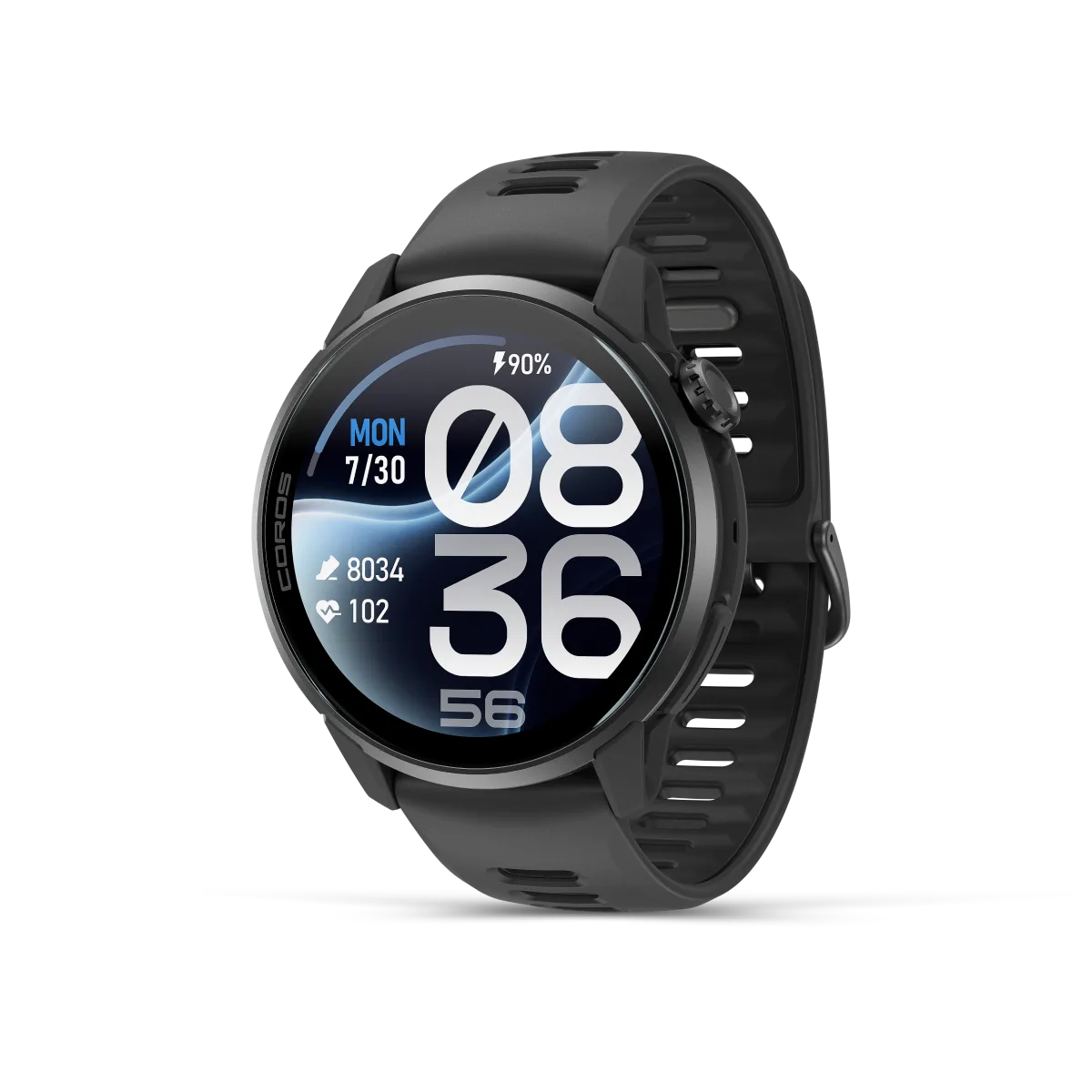
Evidence note: This is a data-based buying analysis, not a hands-on review. Specifications, prices, battery claims, and product images come from the brands’ official U.S. or English-language pages as of September 23, 2026. Real-world GPS, heart-rate, display, and battery performance still need independent testing.
COROS built its reputation by making running watches lighter and longer-lasting than their price suggested. The new PACE 4 Pro reverses one part of that formula: at $449, this is no longer the obvious budget alternative. It is COROS asking to be judged as a premium watch.
The hardware makes a credible opening argument. The PACE 4 Pro combines a 1.47-inch, 466-by-466 LTPO AMOLED display with edge-to-edge sapphire glass, a TC4 titanium bezel, full offline maps, dual-frequency GPS, 32 GB of storage, a speaker and microphone, and a claimed 60 hours of GPS tracking. It weighs 43 g with the nylon band and measures 11.8 mm thick.
That combination—large screen, sapphire, mapping, and genuinely low weight—is the product. The question is whether it is worth $200 more than the PACE 4 now that COROS has added maps to the cheaper watch too.
What is actually new
The display is the headline. At 1.47 inches, it is the largest COROS has used, with a claimed peak brightness of 3,500 nits. An adaptive refresh rate can move between 60 Hz while interacting and 1 Hz when the screen is static. On paper, that should make map panning fluid without paying the full battery cost of a constantly fast refresh.
COROS also moved the PACE line into more durable materials. Sapphire glass is harder to scratch than the mineral glass used on PACE Pro, while the titanium bezel is a meaningful upgrade over the polymer construction of the cheaper PACE models. The official 38 g body weight becomes 43 g with the nylon band—still lighter than many plastic running watches, let alone premium metal ones.
The battery claim is equally ambitious, although COROS’s own pages currently disagree on one number. The detailed overview lists 60 hours in High all-systems GPS mode (45 with the always-on display) and 40 hours in Max dual-frequency mode (30 with always-on). The U.S. store FAQ instead says Max mode lasts 45 hours. We use the more conservative 40-hour figure below until COROS resolves the conflict. Daily-use battery is rated at 21 days. Those are brand estimates, not measured results, and navigation, music, brightness, and frequent interaction will reduce them.
The fourth-generation optical heart-rate system uses a five-channel, multi-light PPG layout. The sensor package also includes ECG hardware, SpO2, skin-temperature sensing, a barometer, and a nine-axis motion sensor. None of that guarantees accurate wrist heart rate during hard intervals; it means COROS now has the hardware checklist expected at this price.
Mapping is the practical upgrade
The PACE 4 Pro carries 32 GB of storage for global landscape and topographic maps with street and trail names, contour lines, points of interest, turn-by-turn directions, and Back to Start. COROS says it doubled the RAM and fitted its fastest processor to make map rendering more responsive.
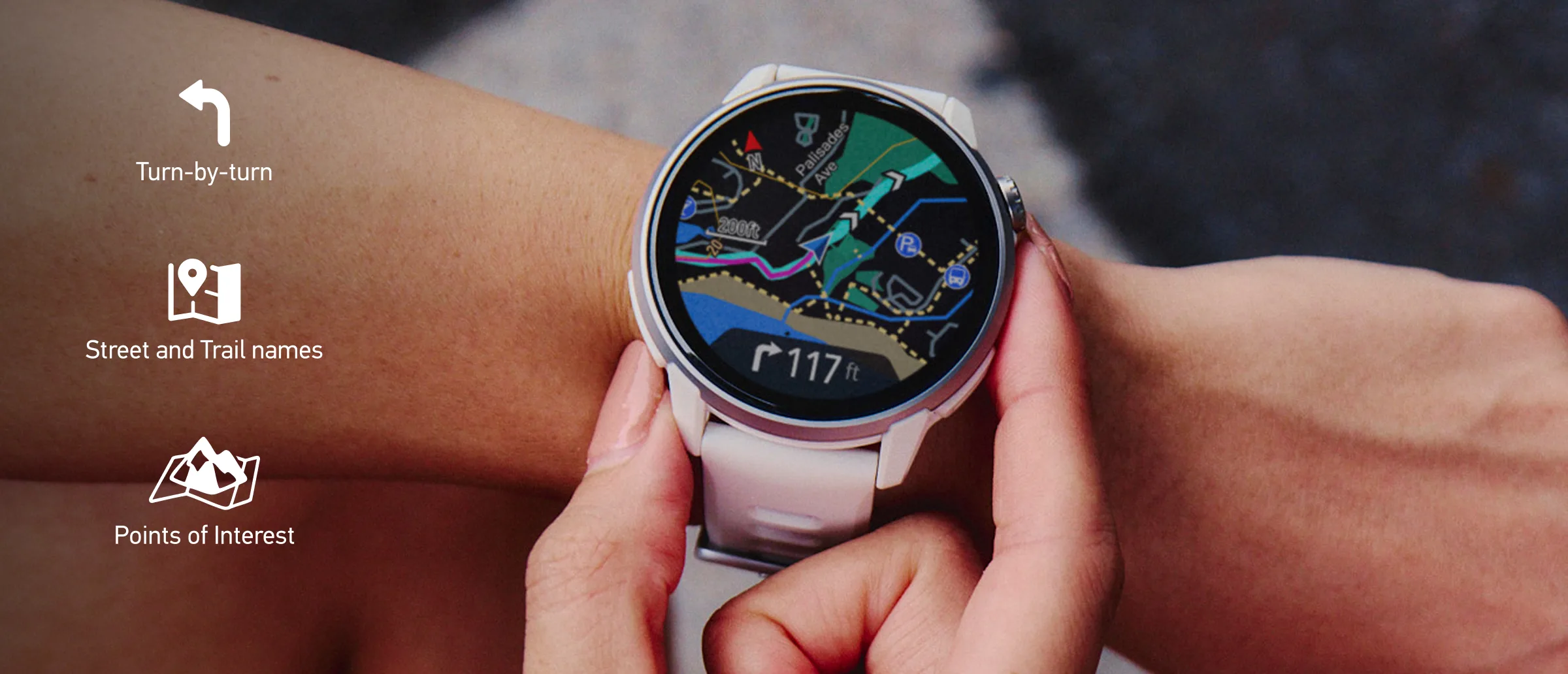
Official COROS image from the English-language PACE 4 Pro product page; labels are shown as supplied by COROS.
This is where the display size matters beyond spec-sheet theater. A route line, upcoming turn, street name, and data field all compete for space while you are moving. A 1.47-inch screen cannot replace a phone or bike computer, but it can make wrist navigation less fiddly.
There is one important complication: mapping is no longer a Pro-only feature. COROS added the same global landscape and topo maps, street and trail names, points of interest, and offline coverage to the $249 PACE 4 in its September 2026 software update. The PACE 4 Pro should render those maps faster and show more of them, but buyers are paying for the experience around mapping—not basic access to maps.
The smaller features that matter
The built-in speaker can play pace, distance, and heart-rate alerts aloud. Paired to a phone, it also supports hands-free calls. The microphone records voice notes during a run, useful for logging fueling, trail conditions, or how a workout felt before those details disappear.
There is onboard storage for downloaded music and audiobooks plus standard media controls. COROS does not advertise the offline Spotify, Amazon Music, or Deezer downloads that Garmin supports, so runners with subscription libraries should not assume feature parity.
Training features remain recognizably COROS: Training Load, Running Fitness, VO2 max estimates, race predictions, Pace Strategy, structured workouts, route building, recovery tracking, and dedicated triathlon and multisport modes. The value is continuity rather than a new metric that changes how runners train.
PACE 4 Pro versus the COROS lineup
Prices below are current U.S. official prices or published list prices. We use the nylon-band weight where COROS supplies one.
| Model | U.S. price | Weight | Display and build | Claimed GPS | Best reason to choose it |
|---|---|---|---|---|---|
| PACE 4 | $249 | 32 g | 1.2-inch AMOLED; polymer | 41 hr | Lowest weight and price; now has offline maps |
| PACE Pro | $299 | 37 g | 1.3-inch, 1,500-nit AMOLED; mineral glass | 38 hr | Larger screen and maps for less than the new Pro |
| PACE 4 Pro | $449 | 43 g | 1.47-inch, 3,500-nit LTPO AMOLED; sapphire and titanium | 60 hr | Biggest screen, premium glass, longest PACE battery, fastest maps |
| APEX 4 42 mm | $429 | 44 g | Always-on MIP; sapphire and titanium | 41 hr | Smaller premium watch for trail, climbing, and mountain use |
Against PACE 4
The $200 gap buys sapphire and titanium, a display that is 0.27 inches larger, more storage and mapping headroom, longer GPS battery, a speaker, ECG hardware, and the newer sensor package. It does not buy a fundamentally different training platform.
For road runners who follow an occasional route, PACE 4 remains the value choice. PACE 4 Pro makes more sense for athletes who navigate frequently, race long enough to value its battery margin, or simply want a large display without wearing a heavy watch.
Against PACE Pro
PACE Pro now looks like the clearance-value option. It still provides a 1.3-inch AMOLED, offline maps, dual-frequency GPS, and 38-hour tracking at $299 after COROS’s 2025 price cut. PACE 4 Pro adds a much brighter and larger sapphire display, premium bezel, speaker and microphone, newer sensors, and 22 more claimed GPS hours.
That is a substantial upgrade, but so is the $150 difference. Existing PACE Pro owners should wait for independent testing of map speed, GPS, and heart rate before assuming the new hardware changes their training.
Against APEX 4
The 42 mm APEX 4 costs $20 less, weighs almost the same with a nylon band, and already combines titanium, sapphire, maps, voice tools, and mountain-specific features. Its always-on Memory-in-Pixel display favors sunlight visibility and efficiency over AMOLED color and contrast.
Choose APEX 4 for trail running, climbing, skiing, a smaller case, and physical durability around rock. Choose PACE 4 Pro for the larger AMOLED canvas, road and triathlon emphasis, and longer claimed all-systems GPS time. The naming suggests a hierarchy; the use cases are actually parallel.
PACE 4 Pro versus Garmin and Suunto
The closest current competitors are not identical. Garmin’s Forerunner 570 is a road-and-triathlon watch with a deeper smart-feature ecosystem but no onboard maps. Suunto Race 2 is a larger, heavier mapping watch with stronger water resistance. That difference is more useful than pretending all three are interchangeable.
| Model | U.S. price | Weight tested by brand spec | Display and lens | Highest-accuracy GPS claim | Offline maps |
|---|---|---|---|---|---|
| COROS PACE 4 Pro | $449 | 43 g with nylon band | 1.47-inch AMOLED, 3,500 nits, sapphire | 40 hr dual-frequency* | Yes, 32 GB |
| Suunto Race 2 steel | $499 | 76 g with silicone band | 1.5-inch AMOLED, 2,000 nits, sapphire | 55 hr dual-band | Yes, 32 GB |
| Garmin Forerunner 570 47 mm | $549.99 | 50 g with silicone band | 1.4-inch AMOLED, Gorilla Glass 3 | 14 hr multi-band | No |
Band materials differ, so the weight column is not a laboratory comparison. It still shows the design trade-off: COROS delivers premium glass and full maps in a remarkably light package.
*COROS’s detailed product overview says 40 hours in Max dual-frequency mode; its U.S. store FAQ says 45. We use 40 here pending a correction.
Versus Suunto Race 2
Suunto gives you a slightly larger 1.5-inch display, 100 m water resistance, and ten more claimed hours in the highest-accuracy multi-band setting. Its $499 steel model is $50 more, 33 g heavier, and uses the same 466-by-466 resolution. The $599 titanium version reduces weight to 65 g but widens the price gap.
PACE 4 Pro is the better paper specification for smaller wrists, road racing, and anyone who values weight and peak display brightness. Race 2 is the stronger proposition for a large outdoor watch, longer maximum-accuracy GPS tracking, and deeper water protection. Independent GPS and mapping tests will matter more than a ten-hour claim for most runners.
Versus Garmin Forerunner 570
Garmin asks $100.99 more for the 47 mm Forerunner 570. It offers Garmin Pay, downloadable music from major subscription services, extensive health and readiness metrics, adaptive coaching, safety tools, and a mature app and accessory ecosystem. It is also available in a 42 mm size.
But the 570 lacks onboard mapping; Garmin reserves full maps for the $749.99 Forerunner 970. Its official multi-band estimate is 14 hours, versus the 40-hour Max-mode figure on COROS’s detailed overview. If full maps and long GPS battery are requirements, PACE 4 Pro wins the official-spec comparison decisively. If payments, third-party apps, streaming-service downloads, and Garmin’s training ecosystem matter more, the 570 can still justify its premium.
Who should buy it
Buy the PACE 4 Pro if you want full offline maps on a bright, large screen; regularly train beyond a marathon; race triathlons or ultras; dislike the weight of traditional premium outdoor watches; and value sapphire glass enough to pay for it.
Buy the PACE 4 instead if most runs follow familiar roads, you mainly need route guidance as a backup, and low weight and value matter more than premium materials.
Choose APEX 4 or Suunto Race 2 if mountain tools, water resistance, or an always-visible outdoor display matter more than minimum weight.
Choose Garmin if smartwatch conveniences and the broader software ecosystem outweigh mapping and battery value—or budget for the Forerunner 970 if you need both Garmin and maps.
The bottom line
PACE 4 Pro is not a simple PACE 4 upgrade. It is COROS compressing much of a premium outdoor watch into a 43 g running-watch body. The sapphire display, titanium bezel, 32 GB of maps, speaker, modern sensor stack, and long GPS claim make $449 defensible.
The harder argument is inside COROS’s own catalog. A $249 PACE 4 now supplies the same training ecosystem and offline map coverage, while a $429 APEX 4 supplies premium materials and more specialized mountain tools. PACE 4 Pro earns its place only when the combination matters: the biggest screen, fast maps, premium protection, and long battery with almost no weight penalty.
That is a compelling specification. It is not yet a verdict. We need independent testing before treating COROS’s brightness, heart-rate accuracy, mapping speed, or battery figures as real-world advantages.
Sources
- PACE 4 Pro official U.S. product page and U.S. store page, COROS, accessed September 23, 2026.
- PACE 4 official product page and PACE 4 launch release, COROS.
- September 2026 software update, COROS.
- PACE Pro official product page, launch release, and 2025 price adjustment, COROS.
- APEX 4 official product page and launch release, COROS.
- Forerunner 570 official comparison specifications and launch release, Garmin.
- Suunto Race 2 All Black official U.S. product page and Race 2 technical comparison, Suunto.