Gear · analysis
Garmin Forerunner 570: Features and Mapping Limits
The Forerunner 570 adds bright AMOLED, training tools and phone-linked calls for $549.99. See how it compares with the 265, 970 and COROS PACE 4 Pro.
Evidence note: This is a specification-based buying analysis, not a hands-on review. Prices and product claims were checked against Garmin and competitor product pages on September 23, 2026. Battery and performance figures are manufacturer estimates; independent GPS, heart-rate, and display testing is outside this article.
Garmin’s Forerunner 570 sits in an awkwardly interesting place. At $549.99, it costs like a premium running watch. It brings a bright AMOLED touchscreen, multi-band GPS, music, Garmin Pay, training readiness, and a speaker and microphone. Yet it does not have offline maps, and its advertised GPS battery is shorter than that of some cheaper rivals.
The 570 is not a new launch: Garmin announced it in May 2025. What matters now is whether its blend of training software and everyday convenience still earns the price, especially beside the Forerunner 265, the map-equipped 970, and watches such as COROS PACE 4 Pro.
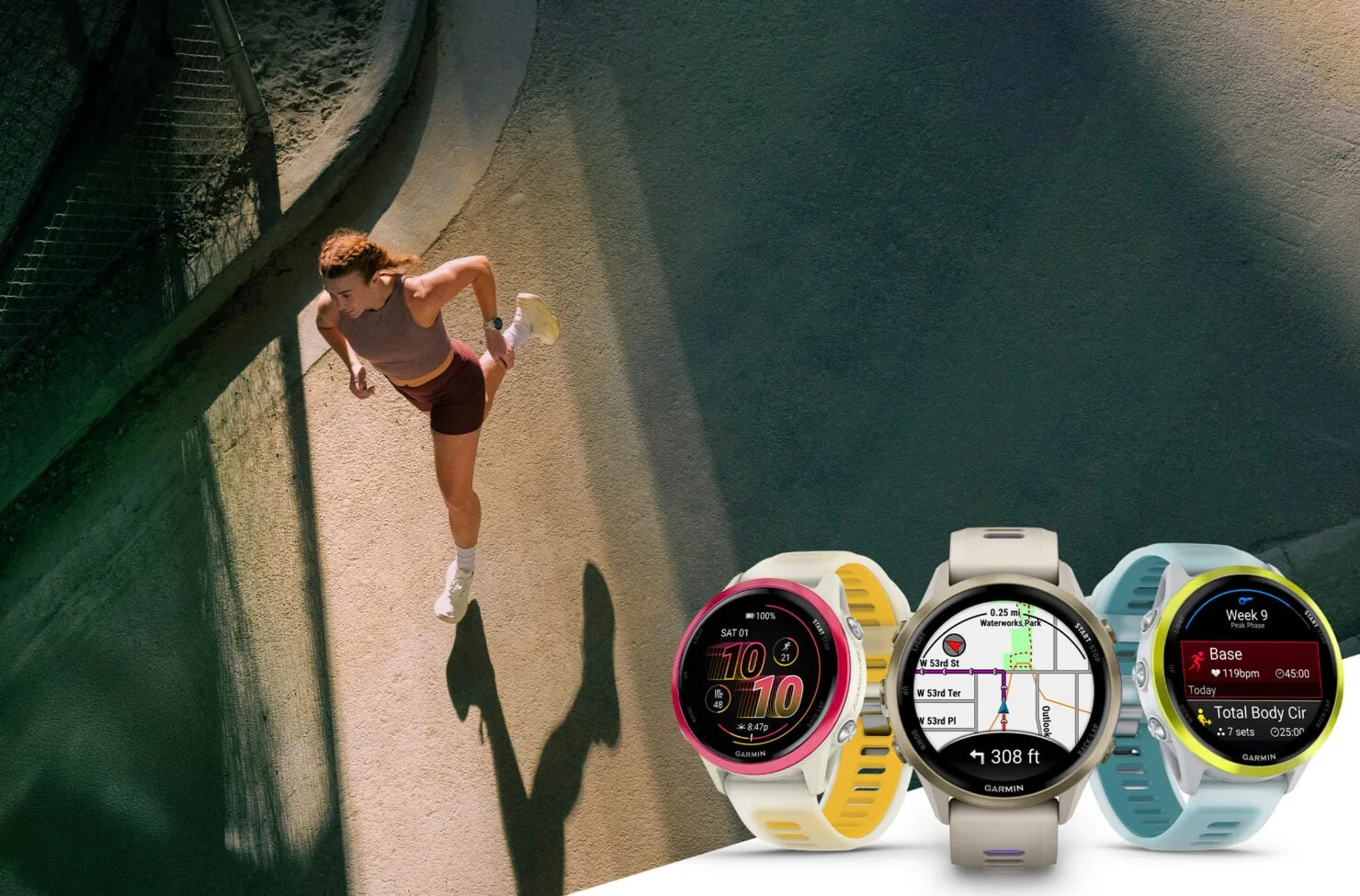
Official Garmin U.S. newsroom image. It shows the Forerunner 570 and 970 launch family.
What the Forerunner 570 does well
The first practical win is choice of size. Garmin sells 42 mm and 47 mm cases at the same U.S. suggested price. The smaller watch weighs 42 g and has a 1.2-inch, 390-by-390 AMOLED display; the larger weighs 50 g and uses a 1.4-inch, 454-by-454 display. Both have an aluminum bezel, Corning Gorilla Glass 3, five physical buttons, and a touchscreen. The 570 is rated to 5 ATM for swimming.
Garmin has given the watch a genuinely broad training toolkit. Runners get multi-band GPS with SatIQ, wrist-based running power and dynamics, training status, acute load, training effect, VO₂ max estimates, training readiness, PacePro grade-adjusted pacing, and adaptive daily suggested workouts. Garmin Coach plans cover running and triathlon, while custom multisport workouts let athletes move through their own sequence of sport types.
The speaker and microphone add a more everyday layer. When paired with a compatible phone, the watch can make and take calls, use voice commands, and invoke the phone’s assistant. That is phone-linked calling, not standalone cellular service. There is also 8 GB of storage for music downloads from supported services, Garmin Pay, an evening report, and skin-temperature tracking.
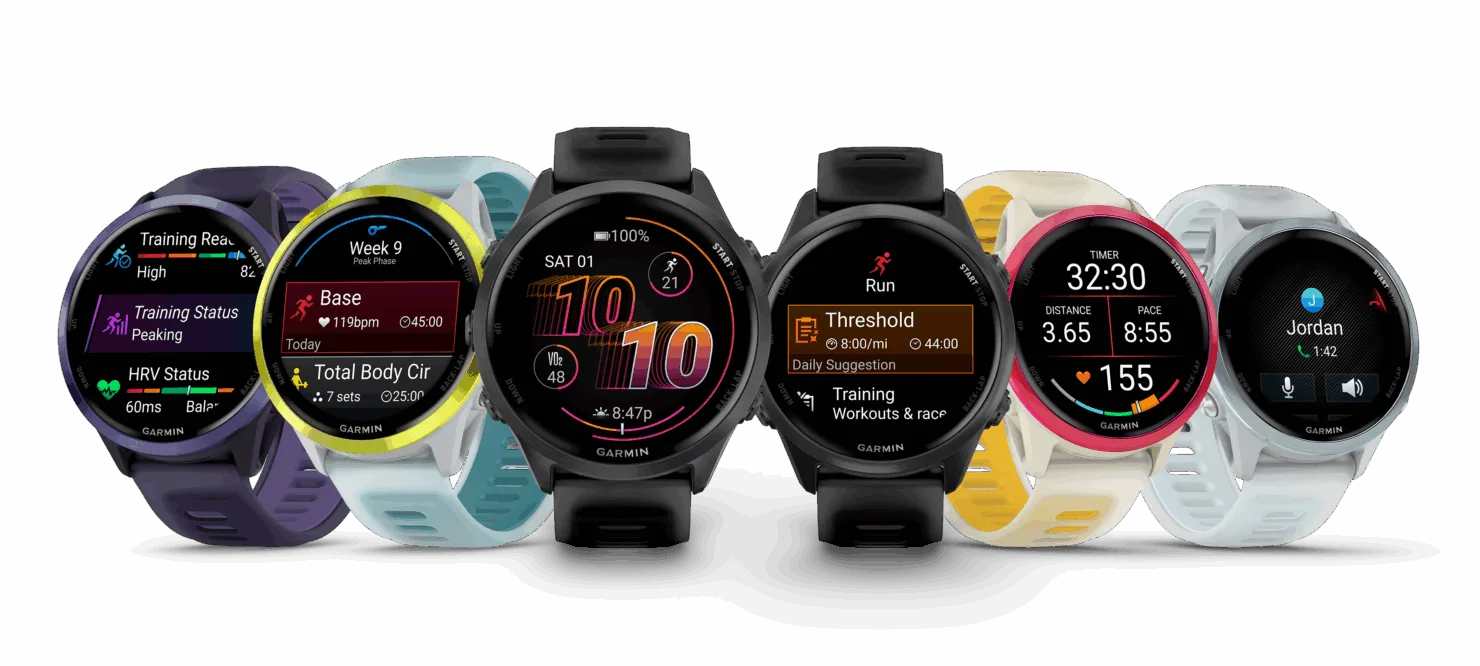
Garmin’s English-language U.S. newsroom image shows several Forerunner 570 colors and interfaces.
The compromises behind the price
The most important omission is mapping. The 570 can follow a course and provide navigation cues, but it does not include the full-color onboard maps found on the Forerunner 970. If you routinely explore unfamiliar streets or trails and want the map rendered on your wrist, that difference is easy to feel.
Battery is the second trade-off. Garmin estimates up to 18 hours in GPS-only activity mode for either size. In all-systems, multi-band mode, the 42 mm model is rated for 13 hours and the 47 mm for 14. Stream music and the multi-band estimate drops to eight hours. Those are maximum estimates under Garmin’s stated assumptions; screen behavior, sensors, music, and navigation affect actual runtime.
That is enough for most daily training and many races, but it leaves less headroom for long events than COROS PACE 4 Pro’s official 40-hour maximum-accuracy dual-frequency claim. The 570’s lens is also Gorilla Glass 3 rather than sapphire, and the aluminum bezel is a practical midrange material rather than a premium titanium one.
Forerunner 570 versus the competition
The table uses the Forerunner 570’s 47 mm version so the size comparison is clear. Garmin prices are suggested retail prices at launch; actual retailer prices can change. COROS and Suunto battery claims use different GPS modes, so they are manufacturer claims, not controlled head-to-head results.
| Model | U.S. list price | Weight | Display and protection | GPS battery claim | Maps |
|---|---|---|---|---|---|
| Garmin Forerunner 570 (47 mm) | $549.99 | 50 g | 1.4-inch AMOLED; Gorilla Glass 3; aluminum bezel | 18 hr GPS-only; 14 hr all-systems multi-band | Course navigation; no onboard maps |
| COROS PACE 4 Pro | $449 | 43 g with nylon band | 1.47-inch AMOLED; sapphire glass; titanium bezel | 60 hr High GPS; 40 hr Max dual-frequency* | Yes |
| Suunto Race 2 (steel) | $499 | 76 g with silicone band | 1.5-inch AMOLED; sapphire glass; steel bezel | Up to 55 hr in dual-band mode | Yes |
The PACE 4 Pro makes the 570’s price harder to defend on hardware alone. COROS asks about $100 less for a lighter watch with sapphire, titanium, offline maps, and much longer claimed GPS time. Garmin’s counter is its deeper training and health interface, payments, broad accessory compatibility, and phone-linked smart features. The choice depends on whether you value maps and battery more than the Garmin ecosystem.
Suunto Race 2 takes a different route: it is heavier and larger, but it combines maps, sapphire, a bright 1.5-inch AMOLED, and a long dual-band estimate at a lower list price than Garmin’s 570. Runners who prioritize mountain navigation or long GPS days should compare it before paying extra for the Garmin name.
Where it sits inside Garmin’s lineup
The older Forerunner 265 remains the most uncomfortable comparison. Its original U.S. suggested price was $449.99, and it already includes an AMOLED display, multi-band GPS, training readiness, music storage, Garmin Pay, and many of Garmin’s core running metrics. The standard 46 mm model weighs 47 g and is rated for up to 13 days in smartwatch mode, 20 hours in GPS-only mode, and 14 hours in all-systems multi-band mode.
The 570’s improvements are real but focused: a brighter, larger display on the 47 mm version; an aluminum bezel; speaker and microphone; skin temperature; an evening report; and updated triathlon and multisport tools. The 265 actually has slightly longer official battery estimates and is 3 g lighter than the 47 mm 570. If you find the 265 at a meaningful discount and do not need calls or the latest software additions, it remains a capable training watch.
The step up to the Forerunner 970 is $200 at suggested retail. For that, Garmin adds onboard maps, a built-in LED flashlight, a sapphire lens, titanium bezel, and newer performance metrics, including running tolerance. The 970 is heavier at 56 g and still uses the same 1.4-inch AMOLED size as the 47 mm 570. Buy it when maps, sapphire, and the flashlight will see regular use; otherwise, the price jump buys capabilities you may not need.
| Garmin model | Launch U.S. price | Weight | What separates it |
|---|---|---|---|
| Forerunner 265 (46 mm) | $449.99 | 47 g | Core Garmin training and multi-band GPS at a lower original price; longer stated battery life |
| Forerunner 570 (47 mm) | $549.99 | 50 g | Speaker and microphone, aluminum bezel, larger display, skin-temperature tracking, newer triathlon features |
| Forerunner 970 (47 mm) | $749.99 | 56 g | Full maps, LED flashlight, sapphire, titanium, and additional performance metrics |
Who should buy it?
Choose the Forerunner 570 if you want Garmin’s training ecosystem, a bright AMOLED, physical buttons, music, payments, and phone-linked calls in a running-first watch. The 42 mm model is a meaningful option for smaller wrists; the 47 mm model gives you the more readable screen.
Choose the Forerunner 265 if it is substantially cheaper and its software feature set covers your training. The 570 is an incremental refinement, not a reason every 265 owner needs to upgrade.
Choose the Forerunner 970 if Garmin maps, sapphire glass, and its flashlight justify another $200. Choose COROS or Suunto if you put a premium on offline maps, longer advertised GPS runtime, and lower cost.
The bottom line
The Forerunner 570 is a polished training watch with a useful size choice and an unusually complete mix of sports software and smartwatch convenience. Garmin’s coaching, readiness tools, payments, music, and paired-phone calls will matter to runners who already use Garmin Connect.
At $549.99, though, the omissions are conspicuous. There are no full onboard maps, no sapphire lens, and no battery advantage over the older 265. The 570 makes the most sense when Garmin’s ecosystem is the reason you are shopping. If your top priorities are mapping, long GPS days, or value, the PACE 4 Pro or Suunto Race 2 makes a stronger specification case. If you already own a 265, wait for a feature you will actually use before upgrading.
Sources
- Forerunner 570 and 970 U.S. launch announcement, Garmin, May 15, 2025.
- Forerunner 570 42 mm U.S. product page and 47 mm U.S. product page, Garmin.
- Forerunner 570 battery-life assumptions, Garmin Support; Forerunner 570 owner’s manual, Garmin.
- Garmin running-watch comparison, Garmin (Forerunner 970 weight and feature tier).
- Forerunner 265 and 965 launch announcement and Forerunner 265 U.S. specifications, Garmin.
- COROS PACE 4 Pro U.S. product page and U.S. store page, COROS.
- Suunto Race 2 U.S. product page and Race 2 technical comparison, Suunto.