Gear · analysis
How Accurate Is Wrist Heart Rate for Running?
Apple's new comparison favors its watch, but the useful question is whether your wrist heart-rate trace is reliable enough for your training decisions.
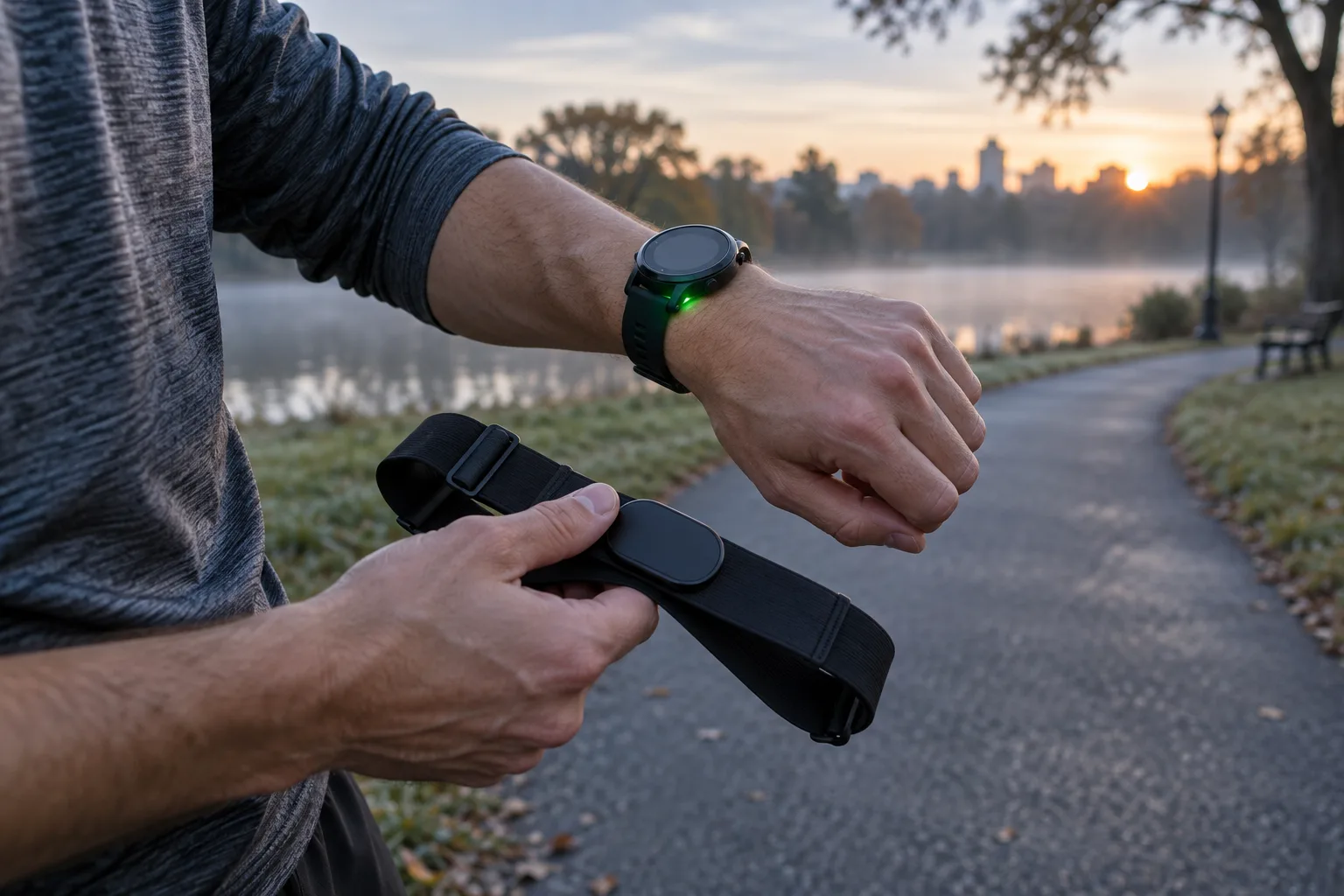
Evidence note: This is a data-based analysis, not a hands-on review. It examines Apple’s September 2026 comparison study alongside independent wearable-validation research. The cover shows unbranded concept gear, not any device discussed below.
Apple has supplied a wonderfully simple headline for its newest watch: the most accurate heart-rate sensing in a wearable. The company also published a nine-page study behind the claim, which is more evidence than a product launch usually provides.
For runners, though, the brand ranking is the less useful question. Your training decision is whether the number on your wrist follows your actual effort closely enough today—during this easy run, this tempo, or this set of intervals.
Those are not the same question. Apple’s study can support the first one within its own test. It cannot answer the second one for every runner and every watch.
What Apple actually tested
Apple enrolled 1,460 adults, and 1,254 contributed at least one paired measurement to the final analysis. Participants wore an Apple Watch Series 12 on one wrist, a comparison device on the other, and a Polar H10 electrical chest strap as the reference. Wrist assignment was randomized so the Apple Watch spent about half its tests on the dominant arm.
The comparison set included current models from Garmin, Google, Huawei, Samsung, WHOOP, and Oura. The protocol covered outdoor running, treadmill intervals, cycling, high-intensity intervals, strength training, and several daily activities. That matters: running can produce cadence lock, while rapid heart-rate changes and a loaded forearm can make an optical signal harder to interpret.
The study did several things well. It planned sample sizes in advance for workouts, used a validated electrical reference, included multiple sites, synchronized devices, compared both mean absolute error and root mean square error, and used 99% confidence intervals. In 139 of 159 activity-by-measure comparisons, Apple Watch error was statistically lower than the comparison device’s error. Eighteen conclusions were indeterminate, and the competitor was better in two resting comparisons by less than 0.5 beats per minute.
That is credible evidence that the tested Apple Watch ranked well in this Apple-run comparison.
A ranking is not your error margin
The paper’s charts report a difference between errors: Apple Watch error minus the other device’s error. They do not give you a universal absolute error for wrist heart rate, and the 139 comparisons are not 139 runners or 139 workouts.
This distinction prevents two common mistakes. You cannot read a bar showing a several-beat advantage and conclude that every non-Apple watch is wrong by that many beats. You also cannot turn the figure into a fixed buffer to add to or subtract from your heart-rate zones. A device may be accurate for a long steady segment yet lag during a fast transition, briefly lock onto cadence, or lose the signal in cold weather. One average number can hide all three.
The study also has limits that should travel with the headline:
- Apple designed, funded, analyzed, and published it. It was not an independent peer-reviewed trial, and the paper does not provide raw data for outside reanalysis.
- Data access differed by device. Most competitors used high-frequency Bluetooth streams, while Apple used an internal logger for the five-second value shown to users. Samsung background data lacked matching timestamps and required a separate comparison method.
- The study excluded people with tattoos or large moles at the device site and people taking beta blockers, among others. Its result therefore does not establish performance in those groups.
- It tested specific 2026 models and software. It does not retroactively rank an older watch on your wrist.
None of those points erases the result. They narrow it to what was actually measured.
The broader evidence is reassuring—and messier
A 2020 systematic review and meta-analysis combined 44 articles, 738 effect sizes, and 15 wearable brands. The pooled mean difference from an ECG or chest-strap reference was small during treadmill walking and running: -0.51 bpm, with a 95% confidence interval from -1.60 to 0.58. Larger mean differences appeared during resistance training and cycling.
That near-zero pooled running average does not mean every wrist reading is within half a beat. Positive and negative errors can cancel, devices and algorithms vary, and an average can look excellent while a time series briefly misses the transitions that matter in a workout. The review tells us wrist optical heart rate can be useful across common activities, not that every second of every run is correct.
That is why the INTERLIVE expert statement recommends validating a wearable against an accurate reference in the population, activity, and conditions where it will be used. “Accurate” is not a permanent sticker attached to a sensor. It is a result tied to a protocol.
When the wrist is enough
For most steady easy runs, long-run trends, and post-run review, a clean wrist trace may be entirely adequate. If heart rate rises gradually with effort, shows no implausible plateaus or dropouts, and agrees with how the run felt, the convenience is valuable. Heart rate is still only one input; our 80/20 training guide explains why time in zones is not the only way to classify training.
A chest strap earns its inconvenience when the decision depends on rapid changes or a tight ceiling: short intervals, repeated hills, a threshold assessment, or a workout in which wrist data has already behaved badly. Electrical straps detect the heart’s electrical activity rather than infer pulse from reflected light at a moving wrist. The Polar H10 used by Apple has shown very high agreement with a reference ECG in published validation work, although no consumer strap is immune to poor contact, a dry electrode, or a failing battery.
Do not confuse either device with a diagnosis. If a reading is surprising but you feel normal, check the fit and the trace before rebuilding your training around one number. If you have concerning symptoms, a cleaner graph is not a substitute for medical evaluation.
Test the watch you already own
You do not need a laboratory to find obvious problems, but one run is not enough to certify a device. Use this as an editorial field check, not a scientific validation protocol.
- Start with fit. Follow the manufacturer’s placement instructions. Apple advises a snug fit on top of the wrist and notes that cold skin, tattoos, and motion can affect readings. Wet the chest-strap electrodes as directed and warm up before judging either trace.
- Record the same session on both devices. Pair the strap to a second watch or recording app if your main watch cannot preserve both streams. Confirm that the clocks and workout start times align.
- Compare the trace, not only the average. Inspect a steady middle segment, each work interval, and each recovery. Look for delayed rises, delayed drops, missing samples, and long plateaus that resemble your step cadence more than your effort.
- Repeat under the conditions that matter. Try a steady run and a faster session. If winter data is the problem, repeat in the cold; if long sleeves disturb the watch, test that setup. Two or three consistent comparisons are more informative than one unusually good or bad run.
- Assign the tool a job. A stable watch can guide ordinary aerobic running and long-term trends. A watch that repeatedly misses transitions can still log distance and pace while a strap supplies heart rate for key sessions.
The same skepticism should apply to polished recovery scores. Our HRV-guided training analysis covers why a precise-looking wearable number still needs context and a personal baseline.
The bottom line
Apple’s 2026 paper is stronger than a slogan: it is large, multi-site, uses a credible reference, and tests difficult activities. Within that company-run study, Apple Watch Series 12 produced lower heart-rate error than the compared wearables in most analyses.
It is not proof that your watch is wrong, that Apple is always right, or that wrist heart rate has one fixed error margin. Treat the wrist as a convenient sensor whose performance you can audit. If its trace survives repeated comparison in the workouts you care about, use it. If it fails at the exact moments that drive your training decisions, add a chest strap before replacing the whole watch.
That is a better buying rule than any leaderboard—and a more honest way to use the data already on your gear shelf.
Sources
- Apple. Apple Watch Heart Rate Accuracy Study, September 2026.
- Zhang Y, et al. Validity of Wrist-Worn photoplethysmography devices to measure heart rate: A systematic review and meta-analysis. Journal of Sports Sciences, 2020.
- Mühlen JM, et al. Recommendations for determining the validity of consumer wearable heart rate devices. British Journal of Sports Medicine, 2021.
- Chung V, et al. Validity of the Polar H10 for Continuous Measures of Heart Rate and Heart Rate Synchrony Analysis. Sensors, 2026.
- Apple Support. Get the most accurate measurements using your Apple Watch, updated March 10, 2026.