Recovery · guide
Measure Your Sweat Rate Without Chasing a Target
Estimate sweat loss with a scale, a bottle, and a training log. Learn the calculation, its limits, and why the result is not an order to replace every ounce.
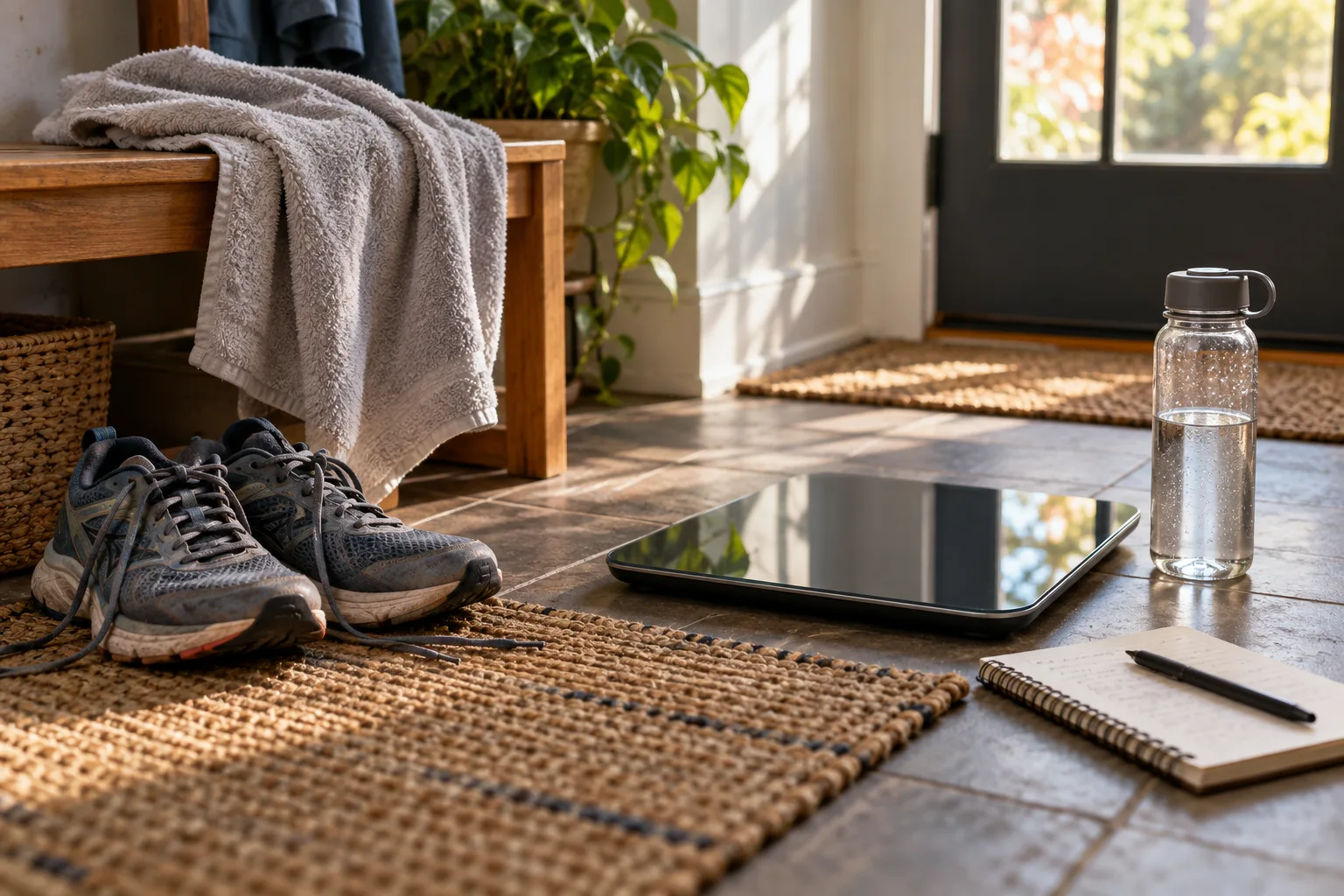
You return from a run a pound lighter. That does not mean you sweated exactly a pound of water: you may have drunk from a bottle or stopped to pee. A useful field estimate accounts for both.
This guide walks through the arithmetic. Our running-watch hydration guide addresses the separate question of what to do with a device’s estimate.
Medical disclaimer: This is general education, not an individual fluid prescription. Read our medical disclaimer. Ask a healthcare professional for a plan if you have heart or kidney disease, a prescribed fluid restriction, or medicines affecting fluid balance. Skip weighing if it worsens anxiety about food or body weight; a sports dietitian can help you plan without this exercise.
Set up an ordinary training observation
The National Athletic Trainers’ Association position statement recommends assessing sweat losses in conditions relevant to your activity. Its field method accounts for body-mass change, drinks, urine, and duration. It is an estimate, not a sweat-collection laboratory test.
Here is our editorial recording workflow:
- Use the same scale on the same firm surface. Weigh immediately before running, after emptying your bladder. Record the reading privately.
- Measure how much fluid is in your bottle. Count what you actually drink, excluding spills or water poured over your head.
- Record any urine passed between weigh-ins. If you cannot measure it, mark the observation incomplete rather than inventing a number.
- After running, towel dry and weigh before drinking again. Use dry, minimal clothing comparable with the first reading; wet clothes retain water and distort the comparison.
- Record elapsed exercise time, distance in miles, temperature in °F, humidity if available, and effort. Choose a routine outing without food intake to keep this simple observation easier to interpret.
Do not deliberately withhold water or extend a run to make the result more dramatic. The measurement serves the training day.
Work through one example
Using pounds and U.S. fluid ounces:
Estimated sweat loss in fluid ounces ≈ (pre-run pounds − post-run pounds) × 15.3 + fluid ounces drunk − urine fluid ounces.
Divide by hours of exercise to estimate fluid ounces per hour. The conversion approximates the volume of water represented by one pound; it does not make a household scale precise.
For example, suppose an ordinary 60-minute run produces these readings:
| Observation | Amount |
|---|---|
| Before running | 160.0 lb |
| After running, dry | 159.0 lb |
| Fluid consumed | 12 fl oz |
| Urine passed | 0 fl oz |
The editorial arithmetic is 1.0 × 15.3 + 12 − 0 = 27.3 fl oz, or roughly 27 fl oz per hour. This is an invented worked example, not a recommended drinking rate. Ignoring the bottle would underestimate the loss; forgetting urine would overestimate it.
The method also captures mass changes unrelated to sweat. Scale resolution and clothing introduce error. Do not extrapolate one short observation into an exact marathon total.
Use a range to plan access, not compulsory sips
Repeat observations on comparable outings before drawing conclusions. Keep cool easy runs separate from warmer or harder sessions. NATA emphasizes individual variation; a single result is not your permanent requirement.
Our editorial use for the log is practical: identify where water is available, decide whether to carry a bottle, and rehearse tolerable drinking during training. Do not make finishing that bottle a workout objective. Our race-day stomach guide covers practicing fueling separately.
The CDC Yellow Book warns against forcing drinks beyond thirst during prolonged exertion. Sports drinks do not eliminate overhydration risk. A sweat estimate cannot measure blood sodium or tell you whether symptoms mean too little fluid, too much, or something else.
Stop for symptoms, not for a better measurement
Stop running for dizziness, unusual weakness, nausea, or a worsening headache. Rest somewhere cool and seek medical care if symptoms persist or worsen. Do not delay care to finish weighing yourself.
Emergency red flags include confusion, seizures, collapse, or trouble breathing. Call 911. Begin cooling someone with suspected heat stroke while help arrives. Do not force fluids into someone confused or unable to swallow safely. CDC describes severe heat illness and hyponatremia as potentially overlapping emergencies that need medical assessment.
The useful outcome is a more informed training log and a workable access plan. Matching every estimated ounce before the finish is not the goal.
Sources
- NATA: Fluid Replacement for the Physically Active (2017). Professional position statement; field measurement, individual variation, and overhydration cautions. Formula converted to U.S. customary units by the editors.
- CDC Yellow Book: Heat and Cold Illness in Travelers. Authoritative guidance on excessive drinking, heat illness, hyponatremia, and emergency assessment.