Recovery · guide
Can Your Running Watch Tell You How Much to Drink?
A sweat-loss estimate can prompt a useful check, but it cannot prescribe every sip. Learn how to compare a watch alert with your own runs and spot danger signs.
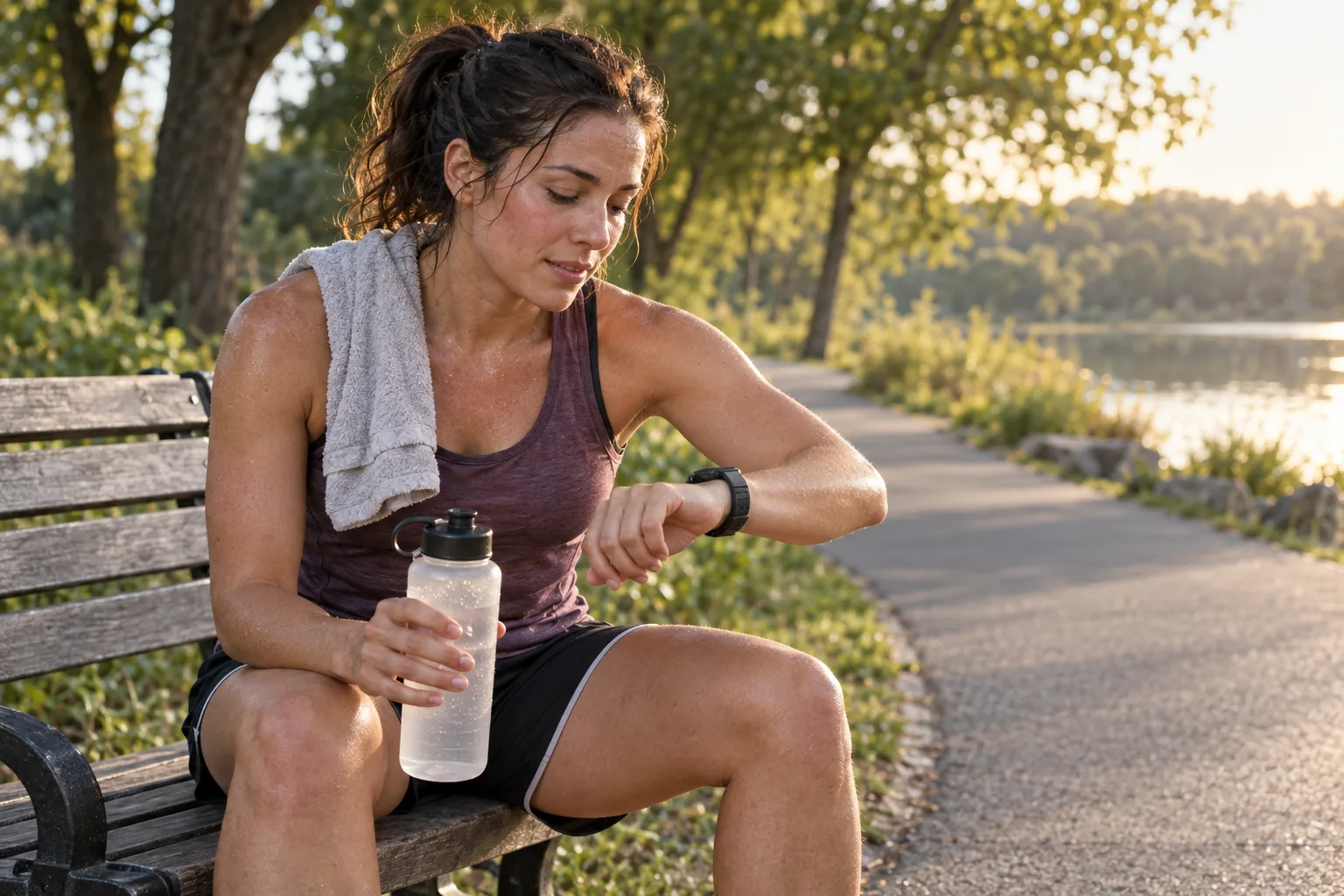
Your watch says you lost fluid on a run and recommends a drink. That reminder may be useful. The number beside it is still an estimate, not a measurement of your blood chemistry or an order to finish a bottle.
Medical disclaimer: This article is general information, not individual medical advice. A watch cannot diagnose dehydration, exercise-associated hyponatremia, or heat illness. If you have kidney or heart disease, take medicines that affect fluid balance, or have been given a fluid limit, ask your clinician how to plan exercise and drinking.
What the watch actually knows
Some watches now turn estimated sweat loss into hydration prompts. For example, Samsung describes its Nutrition Alert as calculating recommended fluid intake from sweat loss relative to body weight during extended exercise. That is the manufacturer’s description of a feature, not an independent validation of its accuracy for your next run.
A wrist device does not directly collect all the sweat leaving your body or measure the sodium in it. The useful question is whether its estimate lines up with your experience under comparable conditions. The National Athletic Trainers’ Association (NATA) position statement says sweat rates vary substantially and recommends individual assessments across realistic environments and exercise intensities. A cool, easy 5 miles and a humid, harder 12 miles should not be treated as the same test.
Build a personal comparison, carefully
NATA’s field method uses body mass before and after exercise, plus what you drank and any urine passed during the session, to estimate total sweat loss. If you want to compare a watch with that method, repeat a few ordinary runs in different conditions. Use the same scale, similar clothing, and dry off before the post-run reading. Record duration, weather, effort, fluid intake, and whether you urinated. Treat the result as a rough range: measurement conditions and non-sweat mass changes can affect it.
This is an editorial way to evaluate a device, not a prescription to replace every ounce lost before you finish. If the watch repeatedly gives a very different result from your own records, do not assume the watch is the more precise instrument. And do not turn a single high estimate into a rapid drinking target.
For a short, comfortable run with water available afterward, elaborate arithmetic may add little. For a long run, plan where you can carry or obtain fluids, then adjust to the weather, your experience, thirst, and how your stomach tolerates drinking. Our summer heat guide explains why effort and conditions deserve attention alongside pace.
More water is not always safer
Both too little fluid and too much can cause problems. The CDC Yellow Book warns that forcing fluid intake during prolonged exercise can contribute to exercise-associated hyponatremia. It advises against drinking beyond thirst just to meet a target. Its guidance also notes that thirst alone may not prevent mild dehydration, so a sensible plan still considers duration, conditions, and access to drinks. These points leave room for judgment; they do not produce one universal ounces-per-hour rule.
A sports drink or salt tablet does not make unlimited water safe. If you routinely struggle with fueling or stomach comfort late in races, our race-day GI guide offers a separate way to practice a plan before race day.
Red flags: stop the run and get help
Stop running if you become dizzy, unusually weak, nauseated, or develop a worsening headache. Move out of the heat, tell another person, and seek medical care if symptoms persist or worsen. These symptoms can have several causes; a watch’s fluid estimate cannot sort them out.
Call 911 for confusion, slurred speech, fainting, seizure, or other altered mental status. Begin cooling someone who may have heat stroke while help is coming. CDC heat-illness guidance treats heat stroke as an emergency. The CDC Yellow Book also notes that confusion after prolonged exercise can signal hyponatremia; diagnosis needs medical evaluation. Do not keep running or try to solve severe symptoms by following a hydration alert.
Use the watch as a cue to reassess, particularly on longer or hotter outings. Your plan should come from repeated experience and trustworthy guidance, with enough flexibility to change when the conditions change.
Sources
- Samsung Newsroom. A First Look at Galaxy Watch Ultra2 and Galaxy Watch9. Manufacturer description of the hydration feature; no independent accuracy claim inferred.
- National Athletic Trainers’ Association. Fluid Replacement for the Physically Active. Position statement on individual sweat-rate assessment and avoiding both insufficient and excessive fluid intake.
- CDC Yellow Book. Heat and Cold Illness in Travelers. Exercise-associated hyponatremia, thirst, and fluid-replacement cautions.
- CDC/NIOSH. Heat-related Illnesses. Emergency heat-stroke signs and first response.