Training · guide
Why Heat Slows You Down—and Why It Pays Off This Fall
Cardiovascular drift and falling plasma volume explain summer pace loss. Train by effort, adapt safely, and bank fitness for cooler race weather.
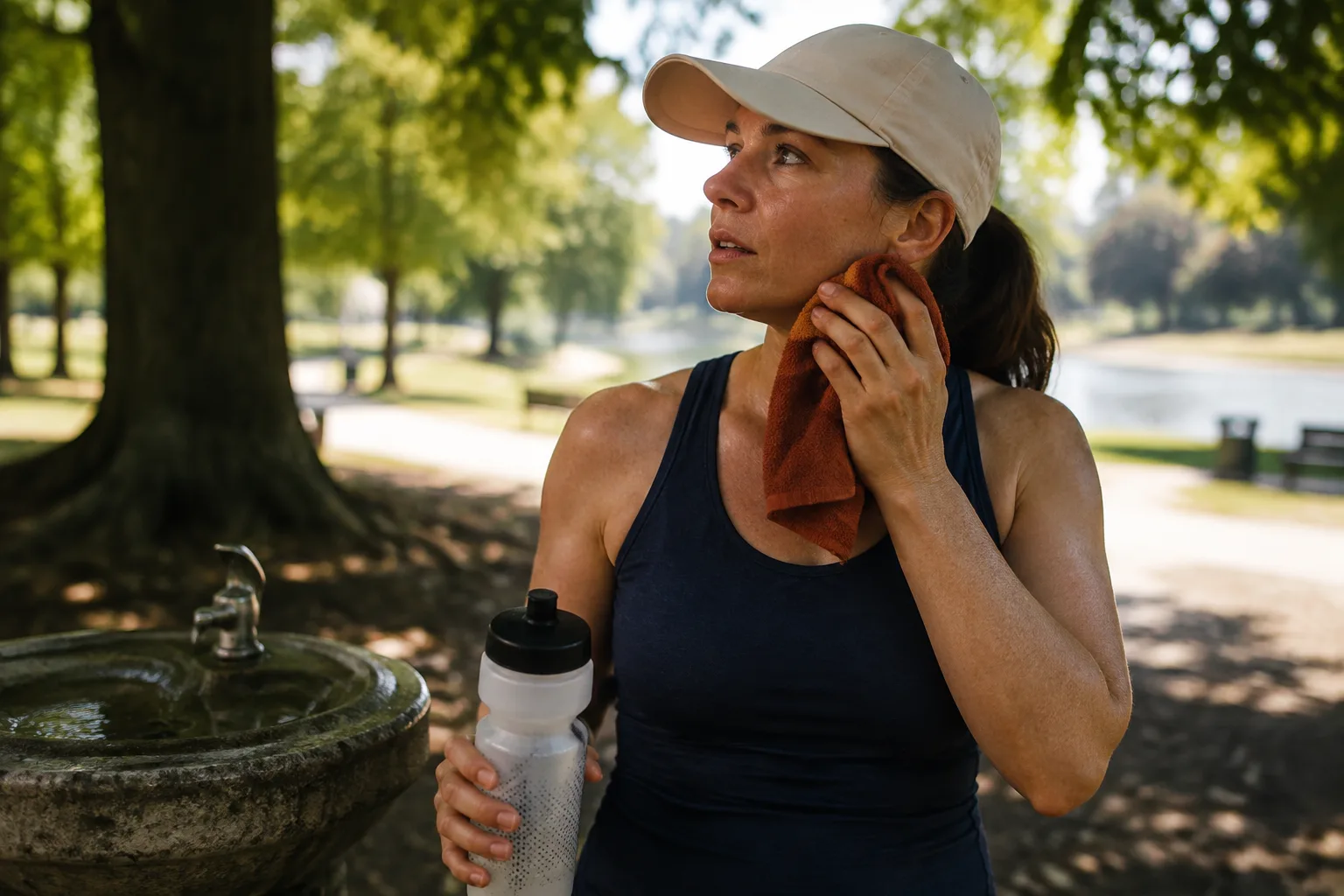
Every July and August, training groups fill up with the same worried confession: “I think I lost it.” Pace is 30 to 45 seconds per mile slower, heart rate is 10 to 15 beats higher, and an easy 3 miles (5 km) feels like a laundry cycle. If your spring fitness seems to have vanished, the problem is usually not your training. It is your blood.
Where summer pace actually goes
Running in the heat creates a supply conflict. Your muscles need blood to deliver oxygen. Your skin needs blood to dump heat. There is only one pump, so the two systems compete for the same cardiac output.
Sweating makes it worse. Every ounce of fluid lost to sweat shrinks plasma volume, which means less blood per heartbeat. The heart compensates by beating more. Exercise physiologists call the result cardiovascular drift: over the course of a hot run, and across a hot training block, heart rate climbs at the same pace while the muscles receive less oxygen-rich flow.
The outcome is the signature summer experience—same effort, slower splits, higher heart rate. Marathon results confirm the physics: finishing times slow measurably as conditions warm, even for elite fields racing in the morning.
None of this is weakness. It is blood flow accounting.
Adaptation is the upgrade
Keep exposing yourself to heat—carefully—and the body remodels. Consensus guidance describes meaningful adaptation within roughly 10 to 14 days of repeated heat exposure:
- Plasma volume expands. A larger blood volume means the heart moves oxygen with less strain.
- Sweating gets earlier and smarter. You start cooling sooner, and you lose less sodium per liter of sweat, which matters on long runs.
- Core temperature runs lower at the same effort, so the drift spiral starts later.
The payoff is not limited to hot days. A classic University of Oregon study had trained cyclists complete 10 sessions of heat acclimation and found about a 7 percent performance improvement when they were retested in cool conditions, alongside higher VO2max. Heat training works a little like altitude: an uncomfortable stimulus that transfers to race weather.
That is the fall dividend. Runners who train through a hot summer, at the right effort, often discover in October that goal pace sits at a heart rate that used to feel easy. It is not luck. It is adaptation being cashed in.
How to train through a hot month
Run by effort and heart rate, not by the watch. Easy days stay easy: conversational breathing, full sentences, effort around 2–4 out of 10. If that means 60 to 90 seconds per mile slower than spring, the aerobic stimulus is the same. Speed work belongs indoors, in the early morning, or as short strides—not as forced long intervals at midday.
Hydrate on a schedule, not by thirst. Position stand guidance from the American College of Sports Medicine is still the reference: start hydrated, drink during exercise to limit losses, and include sodium in long or sweaty sessions rather than drinking plain water endlessly. A practical check is pre- and post-run weight—replace roughly 1.25 to 1.5 liters (about 40–50 ounces) for every kilogram (2.2 lb) lost. Do not overdrink either; forcing large volumes of plain water can cause dangerous hyponatremia.
Shorten before you surrender. During the first two weeks of heat, cap easy runs at 30 to 50 minutes and add a few relaxed strides if you want to keep the legs familiar with speed. Let volume rebuild as adaptation arrives.
Pick your window. Before 7 a.m. or after sunset saves several degrees. Choose shaded routes. When the heat index is extreme—roughly 95°F (35°C) and above, especially humid—the treadmill or an indoor cross-training session is the professional choice, not a defeat.
Plan around race day. If you have a fall goal race, finish your heat block at least two weeks beforehand so you can sharpen in cooler weather with the adaptations already banked.
Who should not chase heat adaptation
Heat training is appropriate for runners with a stable base and no relevant medical conditions. If you have cardiovascular disease, unstable blood pressure, or you take medications that affect temperature regulation or sweating, treat hot-weather training as an indoor season and discuss outdoor limits with your clinician.
And regardless of health status: several consecutive mornings with a resting heart rate 5 to 10 beats above normal, poor sleep, and unshakable heaviness are your body voting for rest. Listen before heat does something worse. Sleep debt compounds heat stress, as the sleep and training guide explains.
Heat illness red flags
Medical disclaimer: This guide is educational and not medical advice; see the site’s medical disclaimer.
Heat exhaustion and exertional heatstroke are predictable if you ignore the warning signs. Treat the following as red flags:
- confusion, disorientation, or slurred speech;
- nausea, vomiting, or stomach cramps;
- chills, goosebumps, or sweating that stops in the heat;
- dizziness, fainting, or a racing heart that will not settle;
- any collapse.
If these appear, stop running immediately, get to shade or air conditioning, start active cooling with ice and water, and seek medical care. Confusion or collapse is a 911 emergency—suspected heatstroke needs aggressive cooling right away, not a cooldown jog. A run ended early costs you one workout. Heatstroke can cost you a season.
The long game
Summer pace loss is not a verdict on your fitness. It is circulation doing triage. Give the body heat exposure on easy terms, hydrate like it matters, and let the adaptation quietly accumulate. When the first cool morning of the season arrives, the training you survived will show up in your splits—because for most runners, the 80/20 principle is even more important in July than it is in March.
Sources
- Consensus recommendations on training and competing in the heat, British Journal of Sports Medicine, 2015.
- Heat acclimation improves exercise performance, Journal of Applied Physiology, 2010.
- ACSM position stand: Exercise and fluid replacement, Medicine & Science in Sports & Exercise, 2007.
- Impact of weather on marathon-running performance, Medicine & Science in Sports & Exercise, 2007.
- ACSM position stand: Exertional heat illness during training and competition, Medicine & Science in Sports & Exercise, 2007.