Recovery · guide
Runner's Face: Running, Skin, and Sun Protection
Sweat is not evidence that running is aging your face. Focus on UV exposure, sunscreen reapplication, and sensible expectations about exercise and skin.
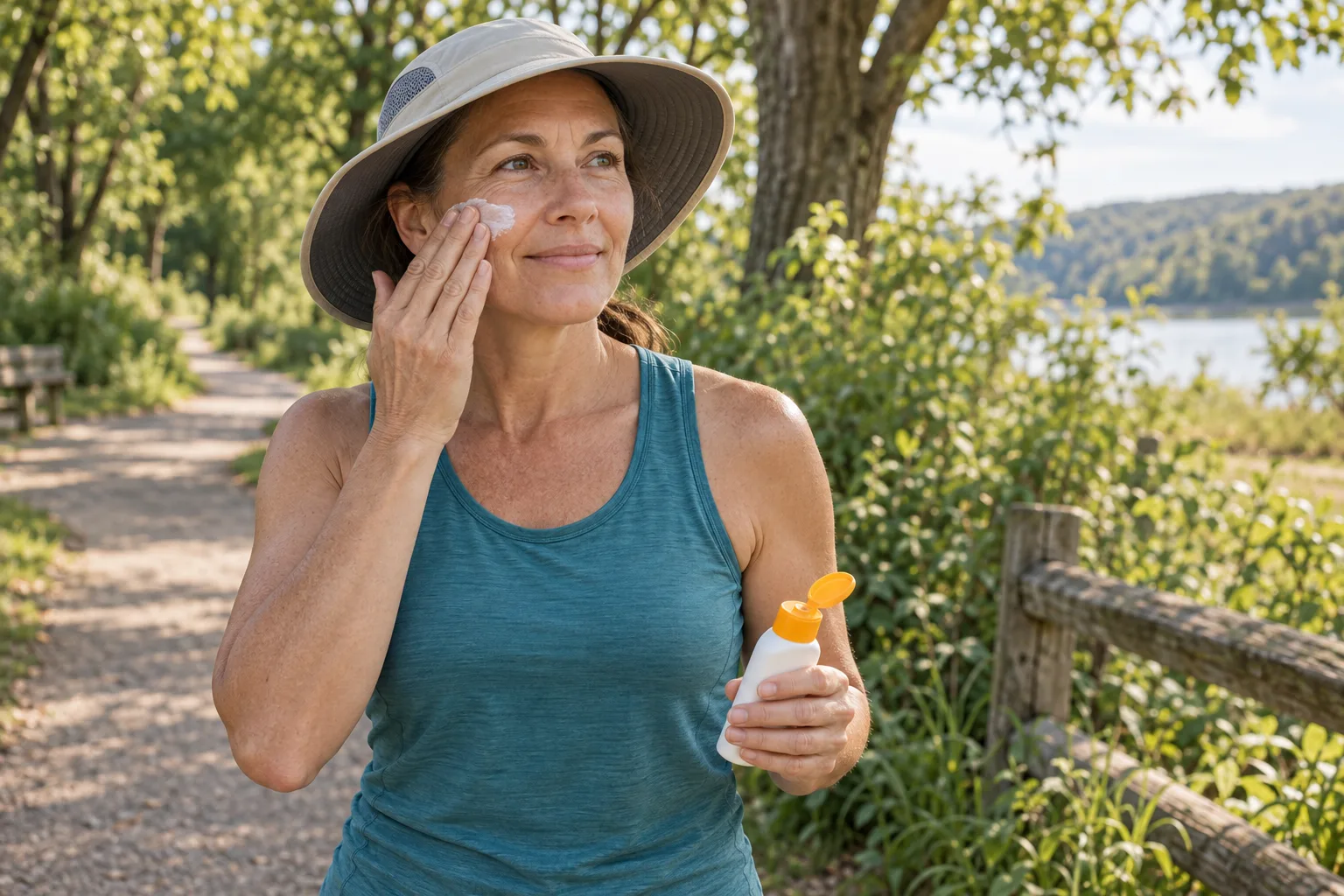
After a hot run, your face is flushed, sweaty, and probably less polished than it looked before you left. That is not evidence that running has loosened your skin. The phrase “runner’s face” bundles several different concerns into a label that does not tell you what caused a change in appearance.
For outdoor runners, the most useful place to start is sun exposure. It is a well-established contributor to skin aging, and it is something you can address without giving up your miles.
Medical disclaimer: This is general skin-health information, not a diagnosis or personalized treatment advice. Seek professional care for persistent skin changes or unexplained symptoms.
Sweat is doing its cooling job
Sweat glands release fluid onto the skin, where evaporation helps regulate body temperature. A review by Baker and Wolfe describes sweat’s composition and the many factors affecting it. That physiology does not demonstrate that sweating causes facial sagging. Read the review.
A damp face after exercise also cannot tell you whether collagen has been damaged. Claims that ordinary running “shakes your face loose” need evidence; the research cited here does not establish that mechanism.
This does not mean sweat cannot feel irritating, or that every skin problem in a runner has the same cause. It means an alarming nickname is a poor basis for deciding to stop exercising.
Repeated UV exposure is a better-supported concern
Research on photoaging describes how ultraviolet radiation can induce enzymes that degrade collagen and other components of the skin’s connective tissue. Over time, sun exposure contributes to visible skin aging. Quan and colleagues’ review explains the mechanism.
Think about the cumulative exposure in your own routine: the lunch run, the weekend outing, the walk home afterward. A cool day is not a guarantee of low UV exposure. A longer run also creates a practical problem if your sunscreen is still sitting on the bathroom shelf when it is time to reapply.
Pack sunscreen like running equipment
The American Academy of Dermatology recommends broad-spectrum, water-resistant sunscreen with SPF 30 or higher. Apply it about 15 minutes before going outdoors and cover exposed areas, including ears and neck. Reapply at least every two hours outdoors and after sweating or swimming. AAD application guidance.
For a runner, the water-resistance label deserves particular attention. In the United States, it specifies 40 or 80 minutes of swimming or sweating. Follow that interval and the product’s directions; two hours is not a promise of protection through continuous sweat. Reapply immediately after towel drying. FDA labeling guidance.
A practical setup is a small sunscreen container in your belt or a loop that brings you back to your bag. Add shade and protective clothing where feasible, plus a hat and sunglasses. SPF is one part of the routine, not a reason to stay in direct sun indefinitely.
Do not turn exercise into an anti-aging promise
A small 2023 study analyzed 56 sedentary middle-aged women after 16 weeks of aerobic or resistance training. Both groups showed improvements in skin elasticity and upper dermal structure; the resistance-training group also showed improved dermal thickness. Nishikori and colleagues reported these findings in Scientific Reports.
The participants were not a representative sample of all runners, and the trial compared two exercise interventions. It does not prove that running reverses facial aging or that a particular workout will change your face. It does, however, complicate the claim that exercise necessarily makes skin worse.
Choose strength training for its role in your running program rather than a promised cosmetic result.
Pay attention to changes beyond your skin
If you are training more while eating less and notice an unwanted change in weight or appearance, review the broader pattern rather than blaming sweat. Our fueling audit offers a starting point for looking at how eating and training fit together.
Persistent fatigue, unexplained weight loss, recurrent injuries, or menstrual changes deserve a conversation with a healthcare professional. A changing, bleeding, or nonhealing skin spot should be assessed by a clinician or dermatologist, not explained away as a running effect.
For acute red flags such as confusion, fainting, or collapse during a hot run, stop running and get emergency help. Sun protection does not prevent heat illness.
You can keep running while being more deliberate about skin care. The next useful purchase or habit is likely to be the sunscreen you actually carry and reapply, not a product sold to fix a vaguely defined “runner’s face.”
Sources
- Baker and Wolfe, Physiological mechanisms determining eccrine sweat composition, European Journal of Applied Physiology, 2020.
- Quan et al., Matrix-degrading metalloproteinases in photoaging, 2009.
- How to apply sunscreen, American Academy of Dermatology.
- Sunscreen labeling and effectiveness testing, FDA.
- Nishikori et al., Resistance training rejuvenates aging skin, Scientific Reports, 2023. Small exercise-intervention study with limited generalizability.