Training · guide
Stair Climbing for Runners: What Transfers?
Can stairs help your road running? Understand the small study behind the claim, how to fit climbing into your week, and when knee pain makes it a poor choice.
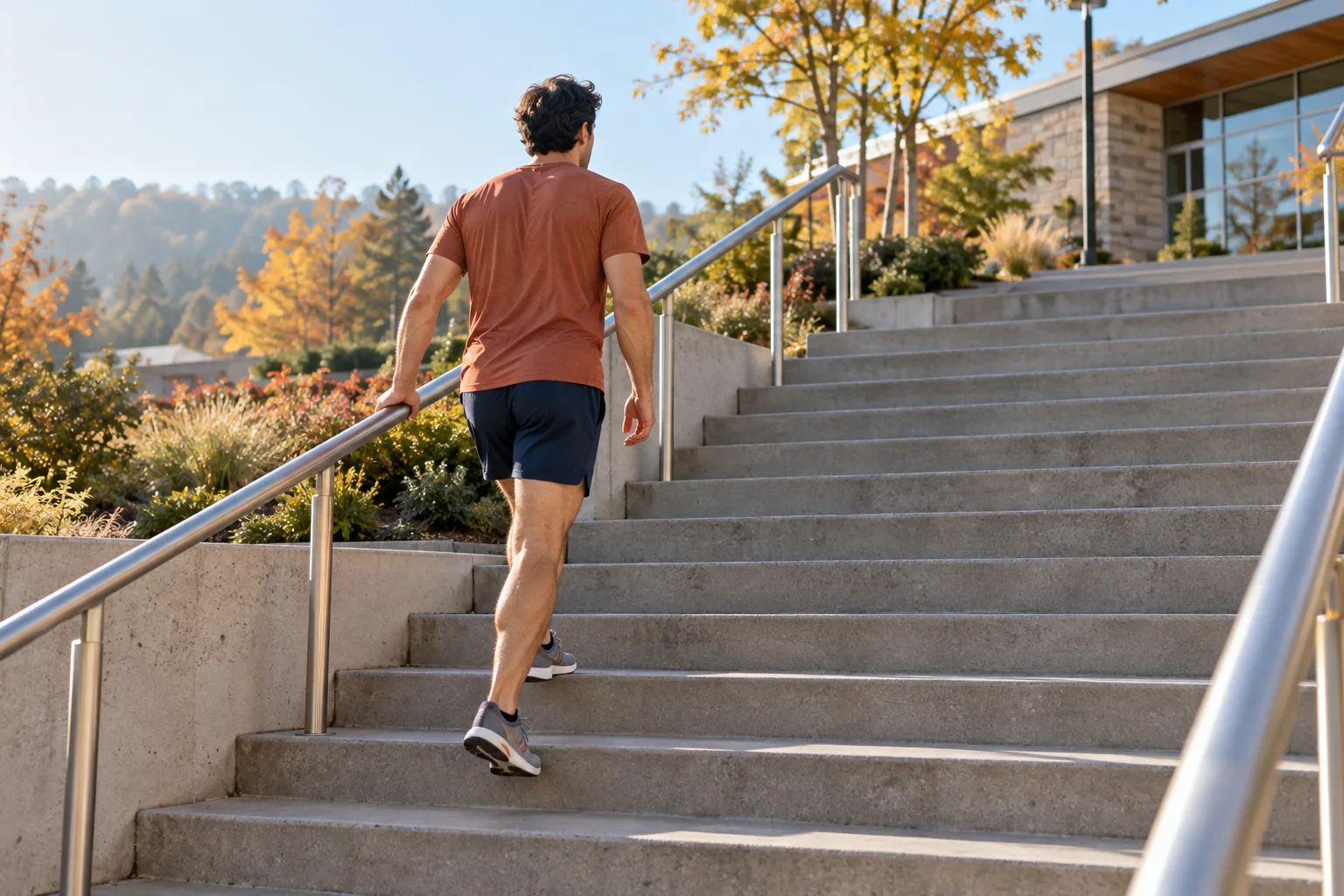
A staircase can make a short workout feel demanding without taking you far from home. That makes it tempting when daylight is scarce or your neighborhood has no hills. The useful question is whether climbing serves a purpose in your running week, rather than how many floors you can collect.
There is evidence that stair-machine training can improve a short running test. There is much less reason to promise an established marathoner a faster finish from adding stair intervals. A machine, an outdoor staircase, and a road hill also present different tasks.
Medical disclaimer: This is general training education, not a rehabilitation prescription. Read our medical disclaimer. Stair climbing is optional; an injury that limits running does not automatically make stairs an appropriate substitute.
What the running study actually tested
A 1993 trial randomly assigned 23 physically active college-age women to stair-machine or running training for nine weeks. They trained four days a week, progressing from 30-minute sessions to 45 minutes at higher intensities. This was a substantial program, not a few flights after work.
The stair group improved aerobic capacity by 12% and cut its approximately 1.5-mile track-test time by 8%; the running group improved those measures by 16% and 11%, respectively. The distance is an editorial conversion of the study’s 2,414-meter test. These are within-group results, not proof that stairs outperform running or that the programs are interchangeable.
The study used a Stairmaster Gauntlet, not repeated climbs and descents in a building. Its small, specific sample and short running test limit what it tells us about experienced road racers, older runners, or marathon performance. The abstract does not establish the benefit of replacing one weekly run with stairs.
Decide what the session replaces
Our editorial approach is to give climbing a place in the schedule before increasing its difficulty. If you already have intervals, a tempo run, and a long run, adding demanding stairs creates another demanding session. Calling it cross training does not remove it from your workload.
For a healthy runner curious about stairs, try a small, comfortable exposure in place of part of an existing conditioning session. Do not copy the research protocol as a beginner workout. Walk first, use single steps, and finish while foot placement and balance remain easy to control. This is a cautious editorial introduction, not a tested dose or a universal progression.
Record time, perceived effort, and how ordinary walking and your next planned run feel afterward. Avoid converting floors into running miles: that arithmetic cannot tell you whether the session duplicated the stress of an easy 3-mile run or a hard workout. If climbing leaves you unable to complete the next appropriate session comfortably, reduce it or remove it.
Our workday running guide can help identify which session actually fits. Stairs are useful only if they solve a scheduling or training problem you have.
Keep road practice in the plan
Climbing can provide an alternative conditioning task, but the trial does not show that it replaces practicing road pace, taking fluids while running, or spending time on your race surface. Keep those skills in your running plan rather than assuming breathlessness on stairs covers them all.
For a hilly road race, use our downhill preparation guide to think separately about descents. Moving upward on a machine does not rehearse running downhill. Keep your strength sessions organized around their own purpose, too; the stair trial did not test stairs as a replacement for resistance training.
There is no requirement to add stairs if your present plan is manageable and progressing. A flat route or another familiar exercise option may be easier to control.
Choose the staircase before the workout
For real stairs, first confirm that exercise is permitted and that you can leave safely at each landing. Keep exits clear, yield to other users, and avoid busy stairwells. These are editorial site-selection checks, not a recommendation to use an emergency stairwell as a gym.
The Canadian Centre for Occupational Health and Safety emphasizes handrails, good visibility, nonslip surfaces, and attention to footing. Apply those principles: choose dry, well-lit stairs with a continuous usable rail. Hold the rail, keep your eyes off the phone, and skip the session if conditions are slippery or visibility is poor.
Plan the return before going up. Use an available, permitted elevator if that lets you avoid repeated descents; otherwise descend slowly with the rail and count that part as activity too. Do not race down to shorten the recovery. On a machine, follow its operating instructions and learn how to stop it before increasing the pace.
Pain changes the choice
AAOS lists stairs among activities that can aggravate patellofemoral pain. That does not diagnose your knee, but it is a reason not to prescribe climbing automatically when running hurts. Our front-of-knee pain guide explains the broader load and care decisions.
Stop running or climbing if pain increases, changes your gait, or makes foot placement uncertain. Seek medical care for persistent or recurring pain, swelling, limping, or pain during ordinary walking and stairs. If a clinician has restricted exercise, ask which alternatives fit those restrictions before trying this one.
Emergency red flags include chest pressure or discomfort, shortness of breath with possible heart-attack symptoms, cold sweat, nausea, or lightheadedness. Stop and call 911 for possible heart-attack symptoms, even if you are unsure; do not try to reach the next floor first.
Judge a stair session by how it fits the rest of your training, including recovery. A floor count alone cannot answer that question.
Sources
- Loy SF, et al. Effects of stair-climbing vs run training on treadmill and track running performance. Medicine & Science in Sports & Exercise. 1993;25(11):1275–1278. Primary trial; details checked against the indexed abstract, not a full-text review.
- Canadian Centre for Occupational Health and Safety. Stairways: Fall Prevention. General stair safety, not an athletic training protocol.
- American Academy of Orthopaedic Surgeons. Patellofemoral Pain Syndrome. Symptoms, activity modification, and clinical care.
- American Heart Association. Warning Signs of a Heart Attack. Emergency symptoms and calling 911.
Sources checked October 27, 2026 (U.S. Eastern). Scheduling, introductory exposure, site selection, and monitoring suggestions are editorial applications rather than a validated runner-specific stair program.