Gear · analysis
Garmin Forerunner 265: Still Worth Buying in 2026?
The Forerunner 265 still offers AMOLED, multi-band GPS, training readiness and music. Here's where it holds up, what it lacks, and when to buy it.
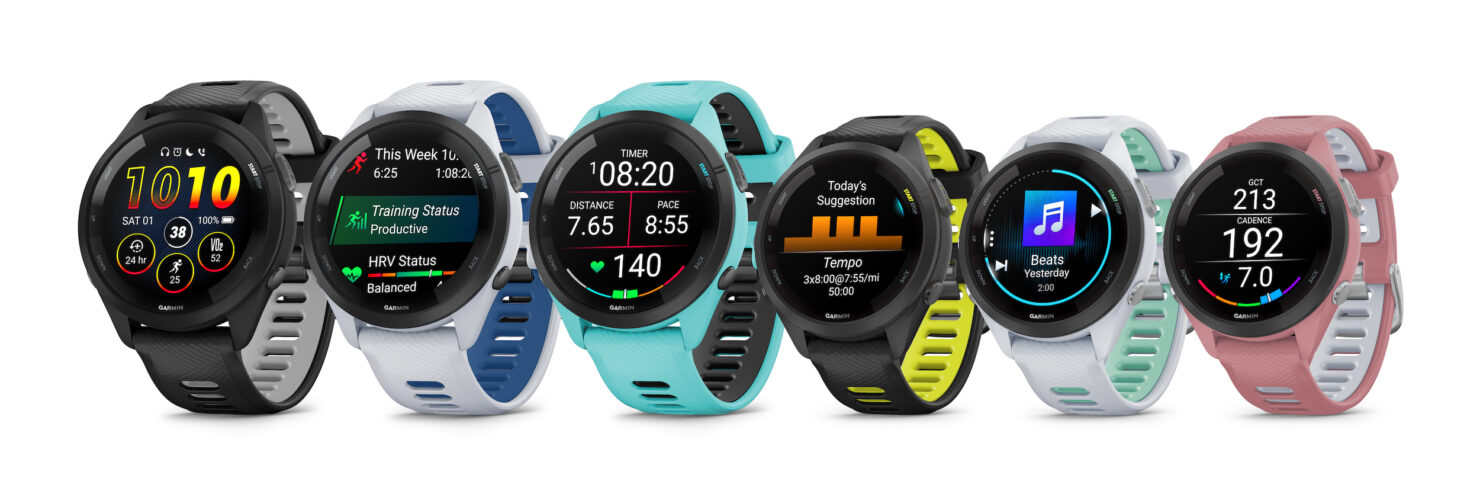
Evidence note: This is a specification-based buying analysis, not a hands-on review. Product claims were checked against Garmin’s U.S. launch materials, comparison pages, and owner’s manual on September 24, 2026 (U.S. Eastern time). Battery figures are Garmin estimates, not independent test results. The $449.99 figure below is the original U.S. suggested retail price, not a verified current sale price.
The Garmin Forerunner 265 launched in March 2023. That age matters less than the question a runner faces at checkout: does a discounted 265 still cover the training features you will use, or is there a reason to pay more for a newer watch?
For many road runners, the answer is still yes. The 265 has a bright AMOLED display, physical buttons, multi-band GPS, wrist-based running power and dynamics, training readiness, music storage, and Garmin Pay. Its main limits are equally clear: no full-color onboard maps, no speaker or microphone for phone-linked calls, and less battery headroom when GPS, multi-band reception, and music are used together.
Garmin’s official image shows the 265 series in several color combinations.
The useful part of the 265 is its training system
Garmin’s morning report brings together sleep, HRV status, weather from a paired phone, and the day’s training outlook. Training readiness combines recovery and recent load signals into a score; daily suggested workouts can adapt to completed runs and an upcoming race entered in Garmin Connect. The watch also offers training status, VO₂ max estimates, training effect, PacePro pacing guidance, and Garmin Coach plans.
The important distinction is between guidance and certainty. A readiness score can help you notice a trend, but it cannot tell you that a particular workout is safe or that a race result is guaranteed. Use it alongside how you feel, your training history, and the conditions on the day.
The 265 can record running power and running dynamics from the wrist without a separate pod. Multi-band GPS and SatIQ’s automatic satellite selection give you options when buildings or tree cover make reception difficult. Those are features Garmin confirms; they do not establish how accurately this particular watch will track your route or heart rate. We have not performed a controlled field test.
Choose the size by fit, not by the letter S
The standard 265 has a 46.1 mm case, a 1.3-inch 416-by-416 AMOLED display, and a listed weight of 47 g. The 265S is 41.7 mm, with a 1.1-inch 360-by-360 display and a listed weight of 39 g. Both have a touchscreen plus five buttons, Gorilla Glass 3, a fiber-reinforced polymer bezel, 8 GB of storage, and a 5 ATM water rating. The standard model uses 22 mm quick-release bands; the S uses 18 mm bands.
| Garmin estimate | Forerunner 265 | Forerunner 265S |
|---|---|---|
| Smartwatch mode | Up to 13 days | Up to 15 days |
| GPS-only tracking | Up to 20 hours | Up to 24 hours |
| SatIQ AutoSelect | Up to 16 hours | Up to 18 hours |
| All-systems multi-band | Up to 14 hours | Up to 15 hours |
| Multi-band plus music | Up to 6 hours | Up to 6 hours |
It is unusual but worth checking: Garmin rates the smaller 265S for longer battery life in several modes. Do not assume the larger case lasts longer. The figures are maximums under Garmin’s conditions; optional always-on display, Pulse Ox, notifications, accessories, and music can change real use. If you expect to play downloaded music through a long event, the six-hour multi-band-plus-music estimate deserves more attention than the 13- or 15-day smartwatch headline.
What navigation and smart features actually mean
The 265 can follow a course, show your track on a simple map screen, alert you when you leave the course, and guide you back toward the start. Garmin’s owner’s manual calls that screen a map. It does not mean the watch has the detailed, full-color onboard mapping Garmin supplies on the Forerunner 965 and newer mapping models. If you regularly explore unfamiliar trails or need nearby roads and points of interest on your wrist, this is a real reason to move up.
For everyday use, both 265 sizes support downloaded music from compatible services, smart notifications, and Garmin Pay. Garmin says Spotify, Deezer, and Amazon Music downloads require a premium subscription. Safety features such as incident detection, assistance, and LiveTrack rely on a paired phone and connection; they are not a substitute for independent cellular service. The 265 does not have the 570’s built-in speaker and microphone for paired-phone calling.
Where it stands beside the 570
Garmin launched the 265 at a U.S. suggested retail price of $449.99. The 570 launched at $549.99 in 2025. Those launch prices establish the intended tiers; your purchase should be based on today’s actual, reputable retailer price and return terms.
The Forerunner 570 gives you a larger 1.4-inch display in its 47 mm size, an aluminum bezel, speaker and microphone, skin-temperature tracking, and newer training and triathlon additions. Yet the 265 already covers the core running tools many buyers are seeking: AMOLED, multi-band GPS, training readiness, running power, music, and payments. Garmin rates the standard 265 for up to 20 hours of GPS-only tracking, compared with 18 hours for the 47 mm 570; both are rated for 14 hours in all-systems multi-band mode.
If the 265 is meaningfully cheaper, those overlapping capabilities make it the stronger value for a runner who does not need calls or the 570’s newer extras. If prices are close, try both sizes on: screen readability, button access, and wrist fit can decide more than one feature line in a comparison chart.
Who should buy it now?
Buy the 265 or 265S if you want Garmin’s training platform, AMOLED, physical button control during workouts, music, and multi-band GPS, and you find it at a worthwhile discount. Choose the S for a smaller fit or the standard model for more screen area.
Look higher in the range if detailed onboard maps, a flashlight, or substantially more GPS battery matter for your routes and races. The 265’s course line is useful, but it is a different navigation tool from a mapped watch.
Keep your current 265 if it still holds enough charge for your longest events and its training features meet your needs. A newer model’s speaker, bezel, or display does not change the fundamentals of your training by itself.
The Forerunner 265 remains a capable running watch three years after launch. Its value in 2026 is conditional on price and fit, not on pretending it is a new release. Compare the actual offer against the 570 and any mapping watch you are considering, then pay only for the difference you expect to use.
Sources
- Forerunner 265 and 965 U.S. launch announcement, Garmin, March 2, 2023 (features and original U.S. suggested retail price).
- Forerunner 265 U.S. specifications and Forerunner 265S U.S. specifications, Garmin (dimensions, materials, features, and battery estimates).
- Forerunner 265 series owner’s manual, Garmin (course navigation and safety-feature requirements).
- Forerunner 570 and 265 product comparison, Garmin; Forerunner 570 and 970 U.S. announcement, Garmin, May 15, 2025.